

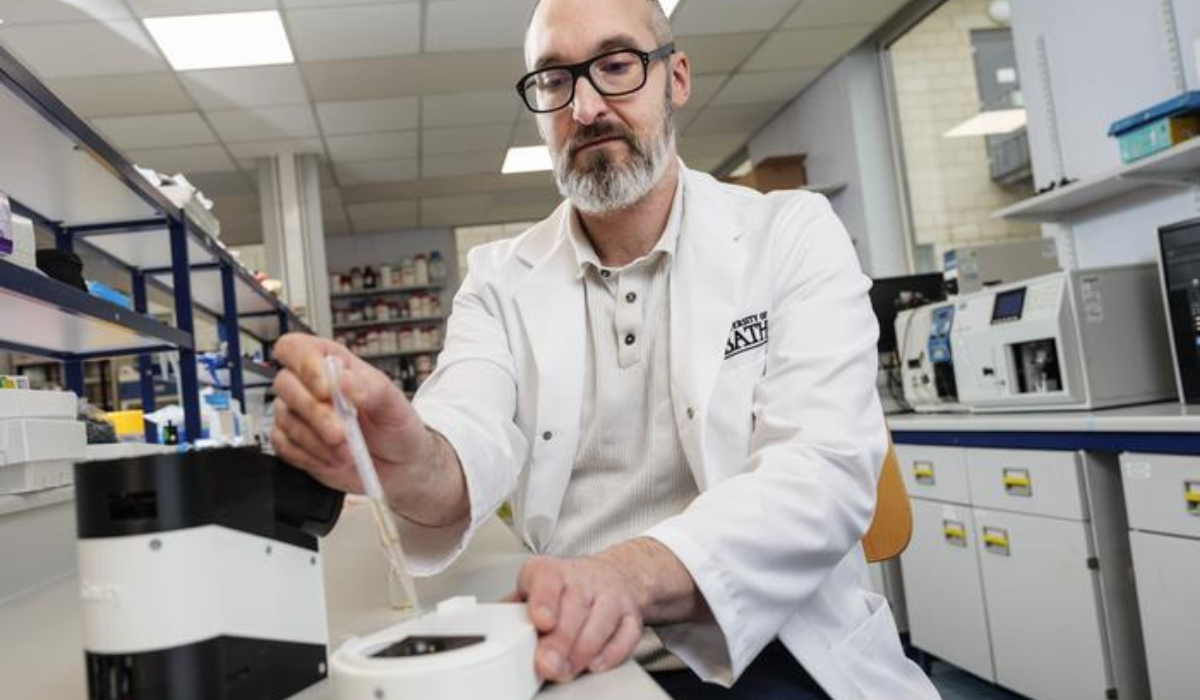
A portable device that can instantly detect dangerous street drugs at extremely low concentrations has been developed by researchers in the UK.
The device, which is being trialled by drug-checking services in the UK, Norway and New Zealand, can identify substances such as benzodiazepines and synthetic opioids that are difficult to detect with existing mobile technologies and are major contributors to drug overdoses globally.
The device, which is similar to an ultraviolet spectrometer, will allow drugs to be tested cheaply and at volume.

Its on-the-spot analysis reveals both the contents of a substance and the concentration of each ingredient.
Biochemist Professor Chris Pudney – who leads the team that developed the technology from the Department of Life Sciences at the University of Bath – says the potential life-saving benefits of this invention are considerable.
By using the device to reveal the precise composition of an illicit substance, the risks associated with taking unknown or adulterated drugs can be reduced significantly.
Professor Pudney envisions the new machine being deployed in areas where illicit drugs are commonly used, such as at clubs and festivals, as well as in services that provide support and treatment for dependent-drug users.
Detecting substances at low concentrations is more challenging than identifying larger quantities of highly pure substances.
The equipment currently available for this task often requires extensive training and can only be operated by chemists.
By contrast, the device invented by Professor Pudney can be operated by a non-expert, yielding results with the simple press of a button, and can detect drugs at extremely low concentrations.
This allows it to determine the potency of a formulation and identify any contamination with undeclared substances.
Many ‘red flag’ substances, including synthetic opioids such as nitazenes and fentanyl, are toxic even in minute quantities, and being able to detect them is critical to saving lives.
Professor Pudney said: “Whatever we’re doing at the moment to prevent deaths from drug misuse isn’t working so we need a new kind of service that can be where it’s needed – cheaply, easily and anywhere.
“Our device would support community harm reduction. Telling people not to take drugs doesn’t work, so different strategies are needed.
“By letting people know exactly what’s in a drug and how strong it is, we can empower them to make safer decisions about whether or not to take it, or to use it in a safer way.”
Image: University of Bath