



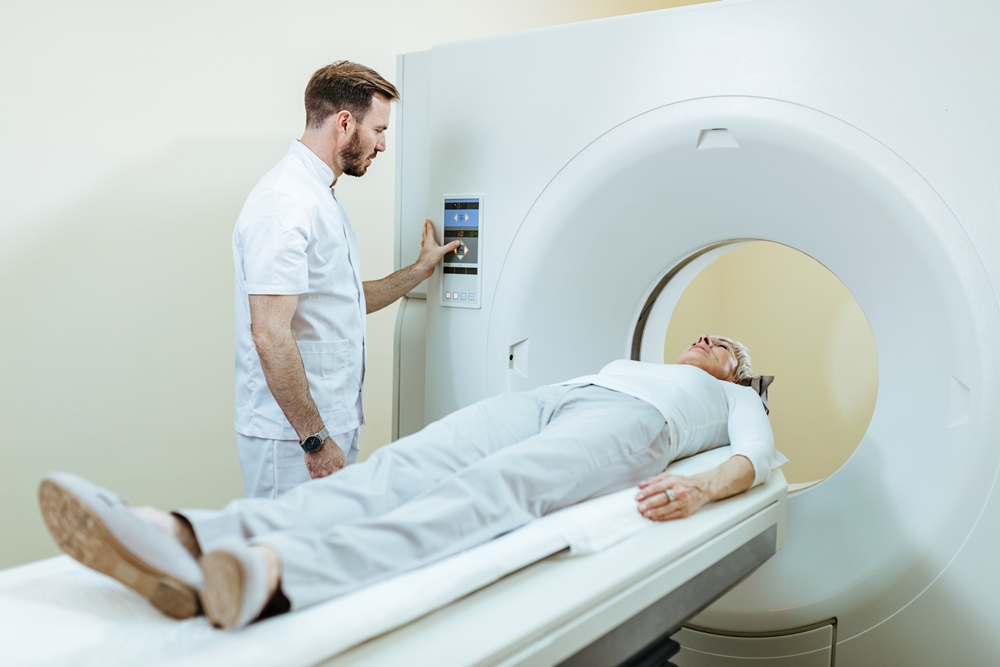
An AI model detected pancreatic cancer earlier and more accurately than radiologists, offering hope of earlier diagnosis, a study found.
Pancreatic ductal adenocarcinoma is the most common form of pancreatic cancer. It has a poor survival rate and is usually diagnosed late, when symptoms and visible tissue changes are often absent.
The model, called REDMOD, was designed to detect subtle tissue texture patterns, known as radiomics, that standard CT scans and the human eye can struggle to spot.
CT, or computed tomography, uses X-rays to create detailed images inside the body.
Researchers said REDMOD could detect the “invisible” signature of pre-clinical pancreatic ductal adenocarcinoma an average of 475 days before clinical diagnosis.
That could help shift some cases from a late-stage diagnosis to stage 0 disease, meaning cancer cells are present but have not spread and treatment is more likely to be effective.
The system also includes automated pancreatic segmentation, meaning it can clearly outline the borders of the pancreas from surrounding tissue and organs without manual input, reducing the risk of variable accuracy.
The researchers said: “This temporal window holds profound significance, as attaining such early detection would substantially augment the probability of cure and improved survival.
They added: “In fact, modelling studies indicate that increasing the proportion of localised [pancreatic ductal carcinomas] from 10 per cent to 50 per cent would more than double survival rates, thereby underscoring that the timing of diagnosis is the single most critical determinant of survival outcomes.”
To test the model, researchers applied REDMOD to abdominal CT scans from 219 patients from several hospitals whose scans had originally shown no evidence of disease after radiologist review, but who were later diagnosed with pancreatic cancer.
In 87 cases, or 40 per cent, this was three to 12 months before diagnosis. In 76 cases, or 35 per cent, it was 12 to 24 months before diagnosis, and in 56 cases, or 25 per cent, it was more than 24 months before diagnosis, up to around three years. Disease was located in the head of the pancreas in nearly two thirds, or 64 per cent, of patients.
These scans were compared with those of 1,243 matched patients who had not developed the disease up to three years later.
The average age of those later diagnosed with pancreatic cancer was 69, with a range of 34 to 88. The average age of the comparison group was 64, with the same age range.
REDMOD was nearly twice as sensitive as experienced radiologists at identifying early malignant changes, detecting them in 73 per cent of cases compared with 39 per cent.
For cases identified more than two years before clinical diagnosis, the model was nearly three times as accurate as radiologists, with rates of 68 per cent compared with 23 per cent.
It also correctly identified just over 81 per cent of scans in an independent group of 539 patients drawn from several hospitals, and 87.5 per cent in the public US National Institutes of Health NIH-PCT dataset of 80 patients, as free of pancreatic cancer.
The pre-clinical changes detected were a reliable indicator of later disease because REDMOD gave the same answer for 90 to 92 per cent of scans when the same patient was scanned again some months earlier.
The researchers said the findings suggest the tool could support earlier detection, but cautioned that it still needs testing in high-risk patients before it can be widely used in clinical practice.
High-risk patients in this context were defined as those with unexpected weight loss and newly diagnosed diabetes.
The authors noted limitations, including that the study group was not ethnically diverse.
Nevertheless, they concluded: “This study validates REDMOD as a fully automated AI framework capable of identifying the imaging signatures of stage 0 [pancreatic ductal adenocarcinoma] in normal pancreas, achieving this with substantial lead times and performance superior to expert radiologists.
“While prospective validation is paramount to confirm clinical utility, the REDMOD framework represents a significant advance towards shifting the paradigm for sporadic [pancreatic ductal adenocarcinoma] from a late-stage symptomatic diagnosis to proactive pre-clinical interception, offering tangible hope for improving outcomes in this challenging disease.”