



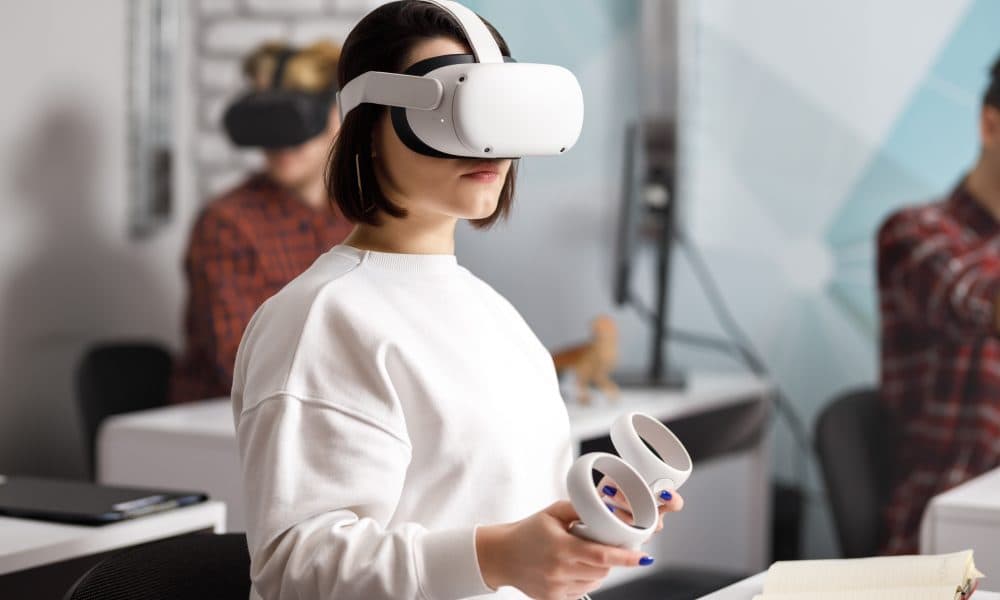
In a new study, researchers from several European universities used VR gaming to study brain network activity in children with clinically diagnosed ADHD.
Until now, ADHD in both children and adults has primarily been studied using brain imaging in a resting state, rather than while actively engaging in tasks where overt symptoms are expressed.

Juha Salmitaival (aka Salmi) is visiting professor at Aalto University.
The researcher said: ‘‘Taking pictures of the brain while memory and attention are being loaded in a virtual world gives us a deeper understanding of what’s going on.
“During the virtual reality game, there were clear differences in brain network activation for kids with ADHD, particularly in the deep structures of the brain and their connection to cortical areas.”
While during functional MRI (fMRI) scanning, subjects were immersed in a world of challenges mimicking those faced by people in the real world.
The game was projected onto a mirror, allowing children to play while their brain activity was scanned.
The results were then compared with scans taken while they were doing more passive activities like watching a video or justresting.
“Interestingly, while at rest, there was no detectable difference between the groups, and there was little difference during video viewing,” said Salmi, findings which also highlight the value of this novel way of collecting neuroimaging data.
The researcher added: “We used to think that abnormal development is mostly a matter of background activity in specific, limited brain regions.
“But these findings indicate that it’s more to do with inter-regional communication between brain regions.
“We found that alterations in brain activity in individuals with ADHD are driven by the human-environment interaction.”
In practice, this means that psychological testing for ADHD in the clinic, or even just brain imaging research more generally, should take place in situations where the individual is actually doing something that would trigger symptoms.
Salmi hopes the study will encourage more extensive research, believing that this method could also help us find out what’s behind the sharp rise in ADHD diagnoses and in the development of non-pharmacological treatments.
It’s not lost on the researchers that gaming in a virtual environment is an excellent way to explore what’s going on in our brains in a world of screens and social media.
Salmi said: “The brain is a complex system that always tries to adapt to its environment, therefore it’s likely being shaped by TikTok, Snapchat and other apps and games as well.”
Similarly, the virtual world contains toys that can trigger impulsivity, like musical instruments, a soft drink in the fridge or the chance to take a virtual shower.
Salmi said: “If the environment is fast paced, with people jumping from one thing to another like a grasshopper, the brain tries to get better at jumping from one stimulus to another.
“But if we become grasshoppers, we can no longer concentrate for two hours when there are very few stimuli.
“Scanning the brain while it’s active could also give us fresh insight into how our brains are changing.”