


The Future Health, Leeds 2025: Industry leaders focus on collaboration to turn intent into real-world impact
Taking stock of the UK’s health tech landscape
On the evening of Thursday 8 May, over 150 leaders from across the healthcare industry came together for the latest event organised by The Future Health.
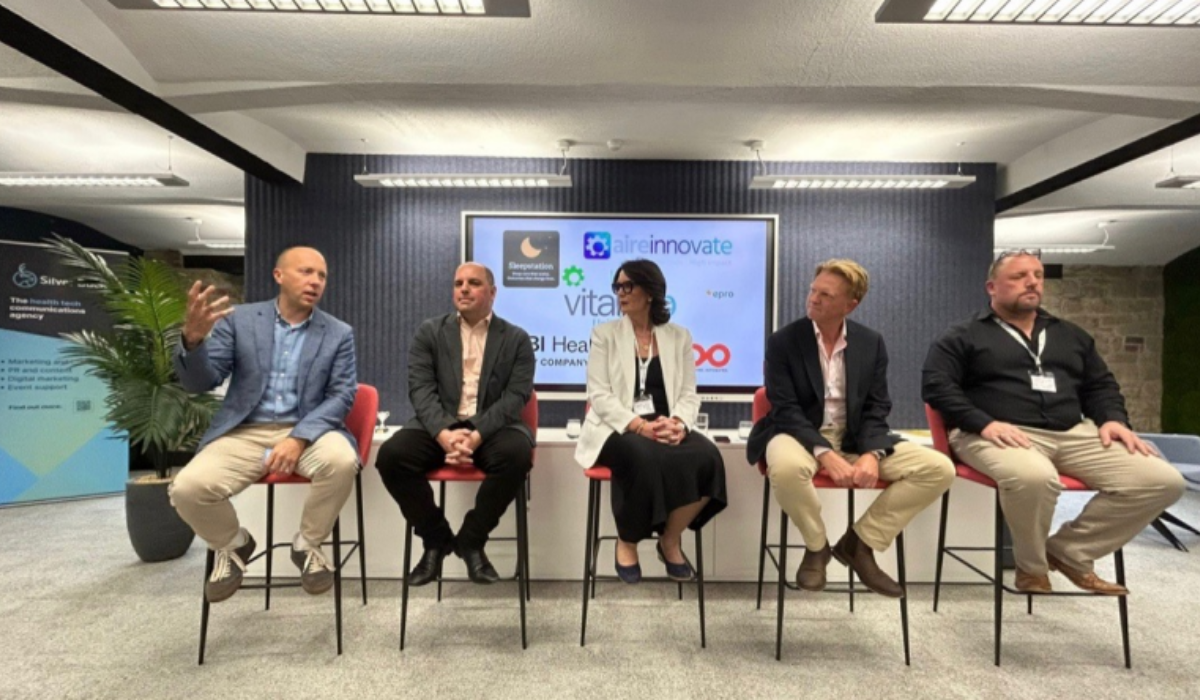
The event, made possible by main sponsor Leeds-based digital transformation consultancy, Aire Logic, started with a lively panel debate chaired by former health secretary Matt Hancock.
The following discussion delivered a no-holds-barred assessment of the UK’s health technology landscape, as industry leaders called on more collaboration to bridge the gap between bold ambitions and tangible outcomes in the NHS.
Joining Matt Hancock on stage, the panel featured Lloyd Price (Founder, Nelson Advisors), Mike Odling-Smee (Founder, Aire Logic), Mike Sanders (CEO, VitalHub), and Heather Cook (CEO, Wellmind Health), representing decades of experience in health and tech innovation.
From policy rhetoric to ground-level reality
Kicking off the session, Hancock posed the question: “Is the government serious about enabling the NHS to embrace new technology—and if so, how will they accelerate it?” While panellists acknowledged recent top-level announcements, scepticism remained high around the system’s ability to execute.
The panel highlighted the industry’s perennial challenge: ‘We live in a world where most innovators don’t know where the next step will come from. The glass is half full, but only just.’ The recent involvement in healthcare discussions by government departments outside of DHSC signalling cross-departmental collaboration was cited as a potential catalyst—but panellists cautioned against misplaced optimism.
The unsolved bed-blocking crisis
In response to the NHS’s ongoing capacity issues, panellists flagged bed-blocking as the single biggest operational threat, choking the entire patient flow pipeline from emergency departments to community care.
‘We cannot pour more people into this problem. We cannot pour more siloed process into this problem. We need integrated solutions, built by multiple companies working together, wrapping around the NHS,’ argued one panellist. The emphasis was clear: without scalable, interoperable systems to manage patient flow, no amount of top-down policy will fix the gridlock.
The survival playbook: Stickiness, ROI, and ruthless pragmatism
Turning to future-proofing strategies for health tech businesses, panellists distilled their advice into three essentials:
- Be sticky: Companies must embed themselves deeply into the healthcare ecosystem, ensuring their solutions are indispensable and tightly integrated.
- Prove ROI relentlessly: With constrained budgets, NHS buyers will only engage with solutions that demonstrate clear, quantifiable returns on investment—’It can’t be a nice-to-have; it must solve immediate pain points,’.
- Orchestrate change, not just products: Building a great product isn’t enough. Vendors must actively manage the change journey—technologically, commercially, and culturally—to deliver real-world impact.
The panel warned against the trap of ‘innovation fatigue’ —the cycle of producing shiny new pilots with no path to scaled deployment. A recurring theme was the need for a clear, structured route to commercialisation, not just more proof-of-concepts.
Interoperability: From buzzword to mandate
Despite years of discussion, interoperability remains a stubborn barrier. Panellists lamented the system’s inertia, noting that technical interoperability is no longer the challenge—cultural and commercial blockers are.
“I got cheered by the RCN for simply saying ‘interoperability.’ That tells you how low the bar is,” quipped Hancock, recalling his experience during his time as health secretary, underscoring the need for mandated, enforced data standards. The consensus: voluntary guidelines won’t cut it—interoperability must be legislated and enforced.
Reframing the universal access argument
The conversation also tackled a persistent policy argument—that technology shouldn’t be deployed if it isn’t universally accessible. Panellists dismissed this as misleading.
‘The notion that we shouldn’t use technology because not everyone can is non-sequitur. It’s like saying we shouldn’t build roads because not everyone drives. We must design systems that enable access while still progressing,’ one panellist asserted.
Clear routes to scale and smarter procurement
As the discussion drew to a close, panellists were asked for the one systemic change they’d implement:
- Make procurement entirely competitive for every single supplier
- A kitemark for transferable evidence, reducing pilot purgatory
- Clearly defined priorities creating a pull not push approach
- Clearer routes to commercialisation
- Smarter procurement, shifting away from backward-looking purchasing frameworks to more imaginative, forward-facing models.
A call for urgency and action
Delegates to The Future Health event delivered a clear verdict: while intent exists at the policy level, execution remains the Achilles’ heel of NHS digital transformation. Without urgent, collaborative action to address systemic blockers—interoperability, commercialisation pathways, and capacity challenges—the digital progress won’t solve systemic issues.
Thank you to main sponsors Aire Logic, and post-event co-sponsors Ebo.AI, Epro, MBI Health, Sleepstation and VitalHub.
In the last 12-months, The Future Health has facilitated four events across London and Leeds, growing each time. If you are interested in attending the next event, follow The Future Health, save the date for 3 July, and look out for more details soon.