

Sara Brammall is managing director of Summit Medical and Scientific.
Eight years ago, the Surrey-based company started partnering with world-leading developers to bring the highest quality rehabilitation equipment to customers across the UK.
It must be exciting to work in this rapidly-evolving field. How have stroke rehabilitation systems evolved over the past decade?
There have been huge advances in rehabilitation technology in the last decade, with new and exciting products coming on to the market every year.
Therapists can achieve results that they couldn’t reach before.
Integrating evidence-based technology that influences neural plasticity, motor learning and behaviour change is key to supporting patients in their motor recovery.
We want to help therapists embrace technology for stroke recovery, and we partner with the world’s best to provide state-of-the-art rehabilitation equipment.
We want to help therapists change lives and achieve the best possible results for their patients across the UK.
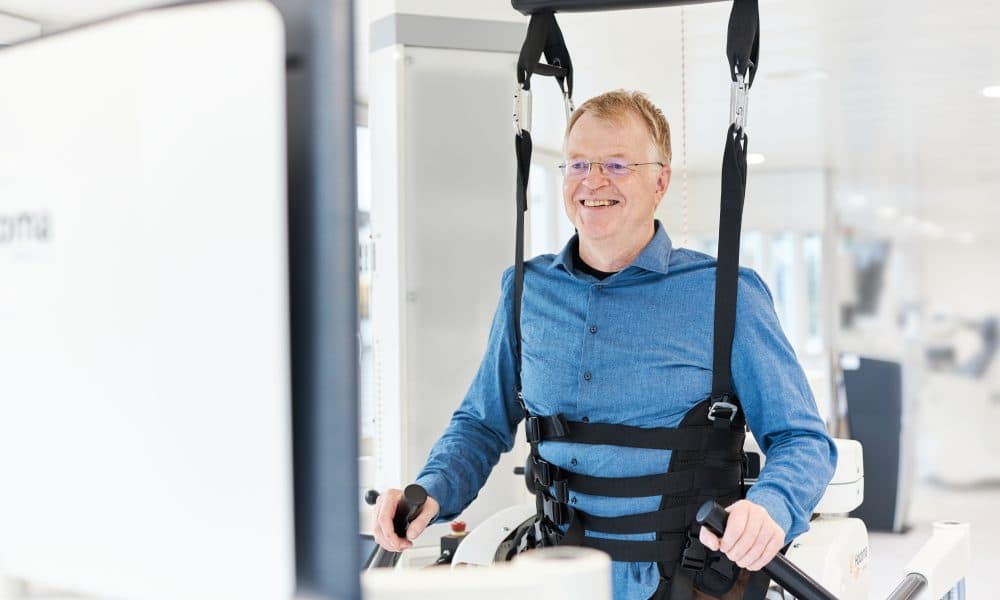
One of our favourite devices, the Lokomat, has actually been around for over 20 years – although it is still evolving even today.
Switzerland-based robotics developer Hocoma have used the knowledge from over 400 studies and over 1,000 Lokomats installed worldwide to develop the LokomatPro Sensation.
What makes the Lokomat superior to traditional rehabilitation and gait therapies?
With traditional manual gait training it is not possible to achieve the high number of repetitions and effort required to achieve the intensity that follows research principles of neuroplasticity in physical rehabilitation.
This is why robotic gait training is a recommendation in National Guidelines for Stroke.
It is also difficult to avoid compensatory movement, during support by therapists or the use of walking aids.
Patients and therapists are exposed to physical strain, even the risk of injury, which is why multiple therapists are typically required to support patients.
This is inefficient and results in a gait pattern that is neither reproducible nor physiologically correct and unlikely to achieve intensity within the NICE 45 minute quality standard.
With the Lokomat, all these limitations are not applicable. Even severely impaired patients can use it, allowing therapy to start in the early stages of recovery.
Robotic gait training with the Lokomat empowers patients with highly intensive, highly effective training.
Patients can achieve hundreds, or even thousands, of steps with just one therapist in a safe and enriched environment.
Real-time feedback, in-depth reporting and a catalogue of engaging exercises helps challenge patients beyond their present capabilities and inform their therapy plan.
The FreeD module that comes with the LokomatPro improves therapy even further by allowing for lateral translation and transverse rotation of the pelvis.
Patients can shift their weight completely over the stance leg, activating their core muscles and experiencing balance.
The new LokomatPro Sensation provides feedback to the patient so they can feel and understand the effort they are making, which further stimulates neural feedback to the brain.
How has the Lokomat improved with the LokomatPro Sensation?
When providing intensive gait training, keeping the patient motivated and engaged is a key component for their recovery.
The LokomatPro Sensation features three special improvements which enhance the patient’s experience, making therapy sessions more fun and personalised for them than ever before.
For the therapist, having more customisable exercises helps their patients push beyond their current capabilities, keeping the patient challenged and getting the most out of each session.
Intelligent algorithms provide adaptive robotic gait support, allowing the patient to feel the support being given as well as experiencing their performance.
This is a revolution for assist-as-needed therapy.
Music and auditory cues are synched with game-like exercises and challenges, boosting motivation, engagement and enrichment for the patient.
Finally, new therapy programs and expansions to existing exercises are offered to individually shape training and see vital progress in real-time.
How do game activities support rehabilitation and help build neuroplasticity in stroke survivors?
Repeating task-specific movements over and over again can be boring and frustrating for patients.
The brain strengthens neural networks when a new task is learned and then repeated, as a movement becomes easier to perform once a neural pathway is established and then well-used over time.
Early, intensive rehabilitation is the best opportunity for building neuroplasticity in stroke survivors, but patients can lose motivation when performing movements through manual therapy alone.
Adding excitement, challenge and competition to therapy via game activities helps the patient maintain the high effort needed for sustained repetition.
When a patient is enjoying a game and trying to beat their high score, participation and excitement are naturally increased and this helps them forget that they are even exercising – all while completing hundreds or even thousands of repetitions.
What do therapists like about working with the Lokomat?
Therapists find the Lokomat is a real game changer for gait rehabilitation. Patients can stand and step earlier, receive truly intensive therapy, and everything is specific and tailored.
For example, the Royal Bournemouth Hospital Acute Stroke Unit have integrated their Lokomat into the care pathway over the last year and have said they could not go back now to manually helping patients to step.
Please tell us more about the hospital’s ‘Walkerbot’ campaign
Therapists at Royal Bournemouth Hospital wanted to be ambitious for their patients, ensuring they were implementing the best evidence and guidance regarding intensity into their practice.
University Hospitals Dorset NHS Charity successfully fundraised to purchase the Lokomat for their Acute Stroke Unit, helping stroke patients relearn how to walk.
The charity ran a fantastic “Walkerbot” campaign, raising the funds in 18 months in spite of the Covid-19 pandemic.
The appeal was supported by countless donations from charitable organisations, local businesses and individuals.
The Lokomat was installed in October 2021, and staff use it in conjunction with conventional physical therapy and occupational therapy.
Patients feel that the Lokomat is a positive additional to their rehabilitation – it’s fun and interesting.
Their comfort is also an important factor, and so the ease of getting set up with the Lokomat is a big plus for them.
We’re hearing that the Lokomat is beneficial not only physically, but psychologically and socially too, which is fantastic.
Is there anything else you would like to add?
Dr Louise Johnson from Royal Bournemouth Hospital said it best in her talk at the 2022 Welsh Stroke Conference about implementing robotic gait training in the NHS: we need to future-proof our services.
The majority of people admitted in hospital post-stroke in 10 years’ time will not only be familiar with technology, but will expect to use it as part of their recovery journey.
Now is the time to look at how technology can be embedded into NHS stroke rehabilitation services.
If you would like to get in touch with us and discuss integrating robotic therapy devices into your service, please feel free to call 01372 459863 or email [email protected].
You can also view all our clinical solutions on our website: https://summitmedsci.co.uk/clinical-solutions
This is an excerpt from our Special Report – Innovations in Stroke