



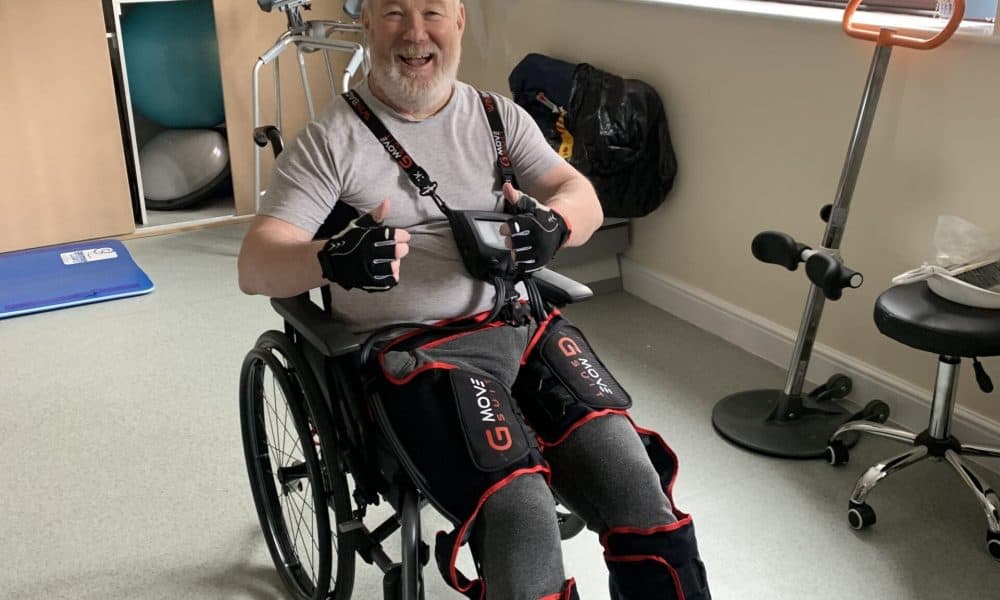
“There comes a point in a patient’s recovery when they have to start to walk independently,” Winback Medical UK and Ireland CEO, Paul Donnelly, says.
“We need to offer patients a cost-effective pathway in and back to the community setting.
“The G Move Suit is that pathway for those patients at late-stage rehabilitation, back into the community, back to health.”
The G Move Suit is designed to make rehabilitation easier by giving the wearer better motor control and stability.
The technology uses compression to hold the lower limbs in position, helping patients walk more easily and allowing them to build up their strength over time.
The suit’s intermittent compression works on four levels:
Effect 1:
Compression stimulates the skin’s baroreceptors, which are then transmitted to the brain, freeing up the patient to focus on their lower limbs
Effect 2:
Motor units are recruited via the muscle compression effect
Effect 3:
Compression activates essential mechanoreceptors located in the fascia essential to the body’s ability to move without conscious thought
Effect 4:
The suit improves venous return, reducing tiredness and optimising rehabilitation.
Paul says:
“It’s a new innovative clinically supported technology.
“Traditional Exoskeletons start at about £25,000 and can reach £100,000, and many obviously can’t be used in the home environment. The G Move Suit is just £3,000.
“Our whole company is built around innovative technology backed by education.
“We’re massive believers in educating not only the clinicians, but also the patients on how this technology used in the right way can help them.
“Our view is that whichever country we’re in, we need to be in an office with the right support available 24/7.
“Patients can be very demanding, and they expect and deserve to have top class support. That’s what we’re here to do.”
Like countless medical innovations before it, the G Move Suit has been adapted from its original purpose.
A product of WINBACK sports medicine background, the suit was designed to flush out lactic acid to support sports rehabilitation.
WINBACK physios saw how the same technology could be used rehabilitate people with spinal injury, multiple sclerosis and stroke, and the technology evolved from there.
Stroke survivors now use the suit throughout their rehabilitation journey, first in a hospital or clinic setting for 10 minutes at a time, with many then renting or buying it to use at home.
“A stroke is devastating and can happen at any time of life,” Paul says.
“We see a lot of young stroke patients, and they will recover. But getting the mobility back – that’s where the G Move Suit comes in.
“It helps strengthen the muscles that they’ve lost because you tend to lose the muscle power in the affected side.”
Winback launched the system about two years ago.
Initially, they were talking directly to patients, but it soon became clear that the suit should be used a professional clinical environment.
The suit’s efficacy has been proven in a recent randomised controlled trial, Paul says.
The trial compared stroke patients recovering with the suit verses those recovering without.
The suit showed significant improvements in lowering blood pressure, reducing fatigue, and improving 10-15-metre walking.
“The other thing we’re looking at is the upper limb,” Paul says.
“Some physios have taken the suit off the legs to use on the arms, enabling patients to hold onto objects.
“From being unknown to us almost three years ago, it’s our customers that have taken us on this neuro rehab journey and our customers have driven the development of the product.
“With their help, we have developed a service that we know is very robust. We know what works and we know which patients will respond.
“If a patient is lazy and doesn’t want to do anything, nothing’s going to help them, not even the G Move Suit.
“But if they want to get better, they are mentally ready and can walk with crutches or a walker or whatever…
“If they’ve got some form of lower limb ambulatory movement, we can assess them and, in many cases, we can help them.”
This is an excerpt from our Special Report – Innovations in Stroke