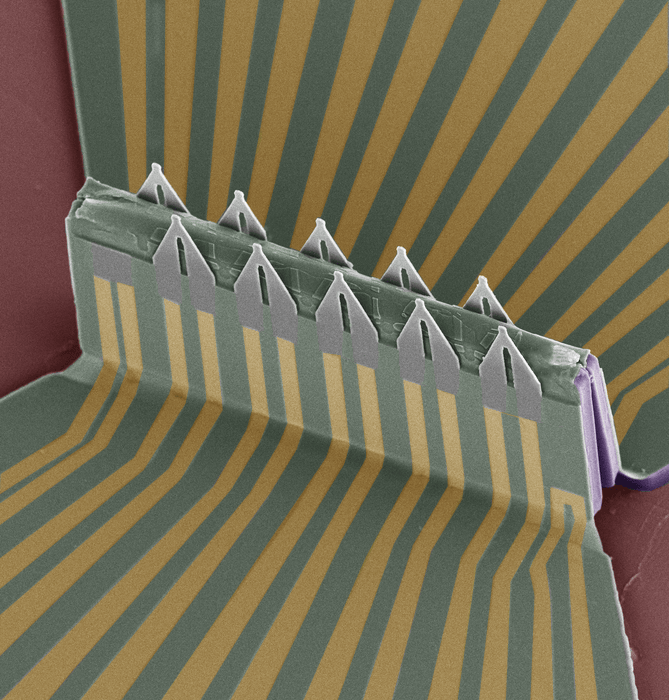




Research has found that tiny graphene neural probes can be used safely to greatly improve our understanding of the causes of epilepsy.
The research shows that unique flexible brain probes can be used to record pathological brain signals associated with epilepsy with excellent fidelity and high spatial resolution.
Dr Rob Wykes of the University of Manchester’s Nanoneuro team said: “Application of this technology will allow researchers to investigate the role infra low oscillations play in promoting susceptibility windows for the transition to seizure, as well as improving detection of clinically relevant electrophysiological biomarkers associated with epilepsy.”
The flexible gDNP devices were chronically implanted in mice with epilepsy. The implanted devices provided outstanding spatial resolution and very rich wide bandwidth recording of epileptic brain signals over weeks.
In addition, extensive chronic biocompatibility tests confirmed no significant tissue damage and neuro-inflammation, attributed to the biocompatibility of the used materials, including graphene, and the flexible nature of the gDNP device.
The ability to record and map the full range of brain signals using electrophysiological probes will greatly advance our understanding of brain diseases and aid the clinical management of patients with diverse neurological disorders.
Current technologies are limited in their ability to accurately obtain with high spatial fidelity ultraslow brain signals.
Epilepsy is the most common serious brain disorder worldwide, with up to 30 per cent of people unable to control their seizures using traditional anti-epileptic drugs.
For drug-refractory patients, epilepsy surgery may be a viable option. Surgical removal of the area of the brain where the seizures first start can result in seizure freedom; however, the success of surgery relies on accurately identifying the seizure onset zone (SOZ).
Epileptic signals span over a wide range of frequencies –much larger than the band monitored in conventionally used scans. Electrographic biomarkers of a SOZ include very fast oscillations as well as infra low activity and direct-current (DC) shifts.
Implementing this new technology could allow researchers to investigate the role infra low oscillations play in promoting susceptibility windows for the transition to seizure, as well as improving detection of clinically relevant electrophysiological biomarkers associated with epilepsy.
Future clinical translation of this new technology offers the possibility to identify and confine much more precisely the zones of the brain responsible for seizure onset before surgery, leading to less extensive resections and better outcomes.
Ultimately, this technology can also be applied to improve our understanding of other neurological diseases associated with ultraslow brain signals, such as traumatic brain injury, stroke and migraine.