



Oxford VR has created a virtual reality therapy that could enable greater access to cost-effective and high-quality mental health treatment.
The treatments, which include powerful simulations of the scenarios in which psychological difficulties occur, are automated and use a virtual coach.
Health Tech World spoke with oxford VR CEO, Deepak Gopalakrishna, who said the immersive therapy has been proven to be successful in reducing patients fears by 68 per cent after an average of just two hours of treatment.
HTW: How did Oxford VR come about?
DG: “Oxford VR started with Daniel Freeman, Professor of Clinical Psychology at Oxford University. Daniel’s been doing research for about 20 years on serious mental illness and how we might close the gap on the availability of care.
“Because there just isn’t enough good care available for those who need it. And these are the people who need it the most, people with psychosis people with serious mental illness, people with schizophrenia PTSD, bipolar disorder, major depressive disorder. There are very few people trained to deliver care for those folks.
“So, Daniel’s been doing research for about two decades on how might we utilise virtual reality to deliver consistently good care and automate that care delivery for people with serious mental illness.
“We’ve shown different proof points of that are work. In fear of heights, it showed that we could cure people essentially or have a really big impact within two weeks of treatment.
“We’ve also published papers on psychosis and persecutory delusions. So Oxford VR came about from that research, which has always been focused around the problem of how do we deliver scalable high-quality care to people with those high acuity conditions.
“So Oxford VR was born about three years ago. I met Daniel about a year and a half ago and we set up a trial for patients with psychosis which we are about to publish.
“It was done in seven different sites at the NHS and we’re looking at sort of what it might look like to increase the availability of that care at the NHS as well.”
HTW: It sounds like something we could really benefit from in the UK
DG: “I think it’s something that the entire world could benefit from. In some parts of the world, there is no access to mental health care at all.
“Some parts of the world focus predominantly on talk therapy and on the social determinants of health, and not really on the high acuity conditions.
“So what we’re bringing to market is a product that can meaningfully address some of those needs. And we’re doing that in a way that is truly scalable, utilising technology.
“And the magic of VR is that you can actually do cognitive behaviour therapy and other evidence-based types of medicine in a virtual space that allows a patient to learn the skills that they might learn in CBT.
“But in fact, it’s been shown that you can do the same kind of learning about four times as fast in a virtual reality environment, as you might do in a in clinical environment.
“So we can actually accelerate even the high-quality outcomes delivered by high-quality care, significantly, while minimising distractions and improving outcomes.”
HTW: How does an average session look?
“The first session almost always focuses on understanding the context of the patient, which involves exploring their fears and problems that they know exist and what they are hoping to solve. They would then get set up with the virtual reality.
“The virtual reality that we have right now is for very specific conditions in psychosis. We decided to focus on psychosis because it has such a broad spectrum of presentations across the higher acuity and serious mental illness.
“So people with PTSD, people with major depressive disorder, people with schizophrenia and bipolar disorder all exhibit psychosis.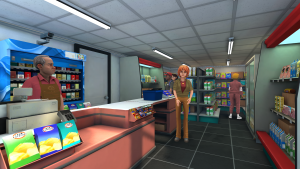
“There are several major causal drivers and social avoidance is one of the predominant ones closely followed by extensive worry, which is what results in some of the symptoms that you see in psychosis.
“So we’re focused on anxious, social avoidance and we start by understanding the situations and conditions that create that response within the individual.
“They do one session every week and it takes about 20 to 30 minutes per session and then they follow up that session with a quick debrief with their clinician.
“And then they do that again the following week and it goes for six weeks. And at the end of six weeks, we’ve been able to measure significant changes or decreases in avoidance, distress and paranoia.”
HTW: How does that compare to a face-to-face therapy session?
“A face-to-face therapy session is usually an hour-long for people at this level of acuity and usually takes place two to three times a week. So the patient would need to either go in or jump on a Zoom call.
“And those sessions tend to be conversational, so the patient might have to imagine a particular situation and work through that situation while describing it to their therapist.
“Whereas, in virtual reality, the patient is putting on the headset and doing it all with an automated therapist in the environment.
“That actually allows the patient to learn skills that result in decreased distress and paranoia, and they have a therapist present the entire time. “
HTW: What’s next for Oxford VR?
“We are expanding the number of treatments that we have. We’re currently treating avoidance in people with psychosis but we will expand it to worry and persecutory delusion. So, we’ll have a lot more treatments available
“People with severe mental illness will be predominantly deployed into clinics.
“And these clinics might either have people come in and do the treatment on-site or it might be in an inpatient scenario where they might already be in a facility or they might have them come in for the first session and then send them home with a headset. So these are all options and there are various versions of the deployment.
“We’re currently doing the expansion and the growth really comes from the number of treatments and the types of indications that we’ll have treatments for. So while we have treatments for psychosis right now we’re also looking at major depressive disorder and other things on the back of it.”