


Paris street medics keep cardiac arrest patients alive with rescue therapy, helped by handheld ultrasound and AR
Emergency medical service SAMU de Paris has achieved an out-of-hospital cardiac arrest survival rate four times the global average, through a rescue therapy called ECPR.
Previously largely confined to hospitals, deployment on Paris streets has been supported in part with the help of handheld ultrasound technology and AR glasses from international health tech company Mindray.
Known in full as extracorporeal cardiopulmonary resuscitation, ECPR temporarily replaces the function of the patient’s heart and lungs – keeping them alive so clinical teams have time to act.
Doctors, nurses, and paramedics within SAMU de Paris mobile ECMO teams (extracorporeal membrane oxygenation) have been amongst the first in the world to deploy it beyond the hospital, and have taken the rescue therapy to Paris streets to buy precious time for patients who would otherwise die.
This has given teams at the scene an opportunity to evaluate the brain, establish circulation, treat, and stabilise the patient for transport, leading to a 38 per cent survival rate for patients treated by the mobile units in homes and in public spaces in the French capital – approximately four times higher than the global average survival for out‑of‑hospital cardiac arrests.
Cardiac arrest remains a leading cause of death worldwide. Delayed treatment can be crucial factor between life and death.
Survival decreases by 7-10 per cent for every minute without effective circulation according to the American Heart Association, which has also reported 3.8 million out-of-hospital cardiac arrests (OHCA) occur worldwide, with an average survival rate of 8-10 per cent.
SAMU de Paris has focussed ECPR on patients when conventional advanced life support has failed, avoiding potentially fatal delays, and providing early intervention for cases that would previously have been declared fatal on scene.
Professor Lionel Lamhaut is professor of emergency medicine at Paris Descartes University, head of the ECMO team in Paris, and associate medical director of SAMU de Paris.
He said: “When advanced life support fails, you have no other choice when the patient is dying on the scene. If we win time, we win life.
“This is a game‑changer in cardiac arrest.
“Some patients with more than 60 minutes of cardiac arrests are alive. That means they can resume their lives, continue to work, and go back home with their family.”
ECPR is common within hospitals, but rare in community settings. In 2025, SAMU de Paris deployed mobile ECMO in ambulances covering a 100km radius around Paris and completing 80 out‑of-hospital ECMO missions.
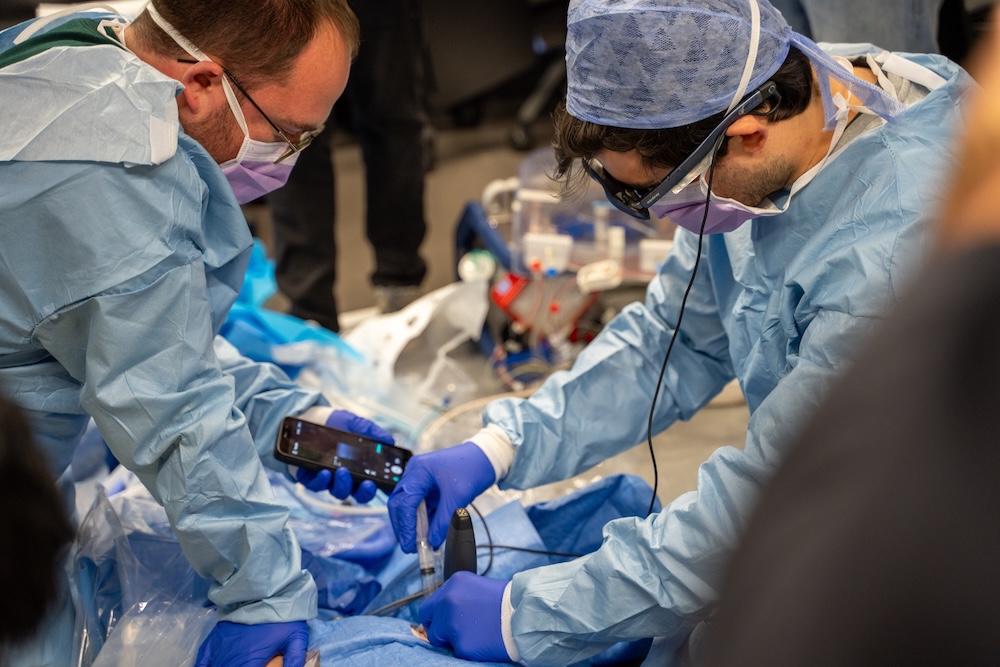
Deployed in high stress and chaotic environments mobile ECMO teams have been supported with handheld ultrasound devices and augmented reality glasses.
This has given medics the best chance of successfully carrying out the rescue therapy – particularly helping them to precisely insert cannulas into major blood vessels, where millimetre accuracy is required.
“The major complication, to be short, is when cannulas are not in the artery and vein, but the cannula is in the wrong vessel,” said Professor Lamhaut. “Everything can succeed or fail by one millimeter.”
SAMU de Paris ECMO teams were equipped with wireless handheld ultrasound system TE Air and Air Realm glasses, both provided by international health tech company Mindray.
The TE Air system is a portable, pocket-sized ultrasound, and has provided medics with detailed vascular imaging to help them achieve rapid and precise cannulation under pressure.
This, along with Air Realm glasses, has also allowed remote support from clinicians in the hospital, who can visualise diagnostic images and picture the scene in real time.
Professor Lamhaut said: “When a young doctor, or an expert doctor has an issue during the ultrasound, all the team can see at the same time via telemedicine images of the ultrasound, and of the scene too. That means we can help from a distance.
“With TE Air and AR glasses, we can visualise the puncture site in real time, without changing the position. More procedures are correctly done with the glasses, and that means we have more lives saved.”
Achievements by SAMU de Paris have been recognised internationally, with services in other parts of the world adopting similar approaches.
European marketing manager at Mindray said: “As global pioneers, mobile ECMO medics at SAMU de Paris have shown the world what’s possible when it comes to helping more cardiac arrest patients survive outside of the boundaries of hospital walls.
“We are privileged to support such impactful work that is inspiring more emergency services to examine how they can apply the model for their own patient population.
As Professor Lamhaut has said, ‘The future of ECMO is everywhere’.

 Listen: Can AI help make food truly medicine?