



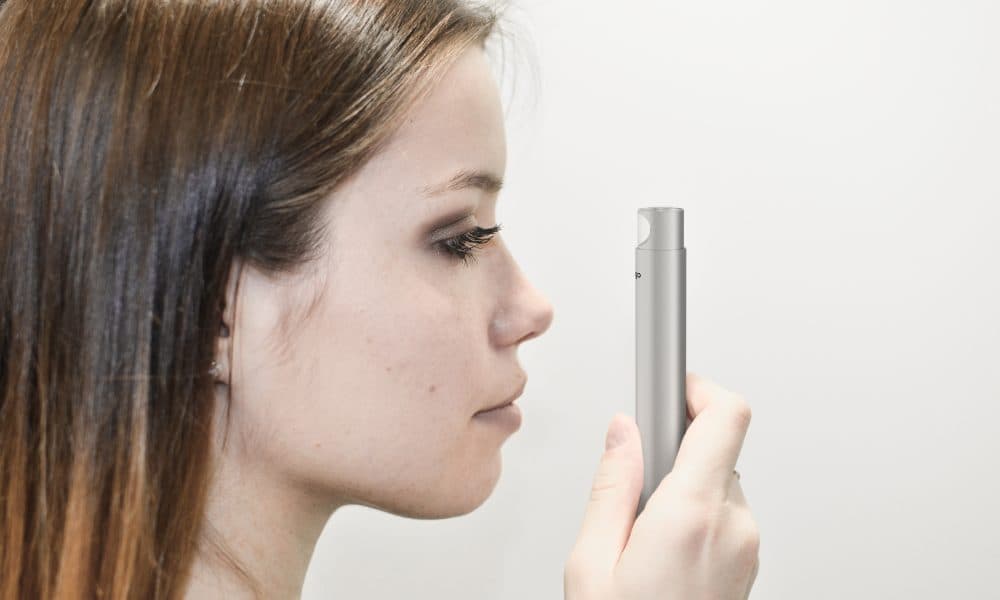
Daniele De Iuliis, who spent 27 years in Apple’s Industrial Design Team, has turned his focus on creating a non-invasive glucose meter that works by taking a simple scan of the eye.
With the number of people living with Type 2 diabetes increasing each year, designer Daniele De Iuliis suggests that a “pain-free, 21st century solution” to glucose testing is “long overdue” and has set his sights on helping to deliver it.
After 27 years working in Apple’s Industrial Design Team, during which time his name appeared on over 400 patents for some of the company’s most iconic products, De Iuliis became a founding investor in Occuity, a Reading based start-up developing an optical device to non-invasively measure glucose in the blood.
The device will work by safely shining a low power beam of light into the eye to measure subtle changes and determine glucose levels within the aqueous humour, which has been demonstrated to very closely match glucose within the blood stream.
The Eye – A window on your health?
De Iuliis describes the concept of the “Occuity Indigo” as a pen-liked device that is both easy to carry and use, highlighting that it will need no consumables and can be used without the stigma associated to current finger stick devices.
De Iuliis comments:
“Having witnessed existing finger stick testing first hand, I think the idea that you can easily take a pain-free measurement of yourself or a loved one, young or old, is most definitely a game changer.”
A way to non-invasively measure glucose has long been viewed as the ‘holy grail’ of testing for people with diabetes, but as yet, a truly non-invasive device has been allusive.
Occuity CEO and co-founder, Dr Dan Daly, believes that the eye represents a fantastic opportunity to solve this complex problem.
Daly suggests:
“Most attempts to deliver a non-invasive solution for measuring glucose have been focused on the skin, using techniques such as near-infrared spectroscopy and reverse iontophoresis.
“Whilst some of these have shown success in studies and controlled environments, they have tended to fall down in real world testing.
“The skin has many variables that affect the results such as the temperature, pressure, sweat and colour. The eye on the other hand is a very stable medium.
“For starters, the eye is “designed” to let light in, and our technology embraces this fact to make measurements in the aqueous humour which is situated at the front of the eye and contains a fluid which is an ultrafiltrate of blood.

Daniele De Iuliis by Michal Venera
“This means that it is very similar to the blood in our veins but does not have red blood cells.
“Studies have shown that the levels of glucose in the aqueous humour changes very quickly in relation to the change in the blood.”
To measure the glucose levels in the eye, Occuity’s technology works by accurately measuring the refractive index – the optical density – of the aqueous humour.
“The refractive index changes with the concentration of glucose and this allows for a glucose measurement to be made non-invasively via the eye.”
The International Diabetes Federation are calling on policymakers to increase access to diabetes education to help improve the lives of the more than half a billion people living with diabetes worldwide.
That’s One in 10 adults around the world, an estimated 537 million people. Perhaps even more significantly, almost half of these – 240million people – do not know they have it.
As Daly points out:
“Early intervention is crucial as the longer diabetes goes undetected, the more damaging its effects can be.
“Currently we are not aware of any national diabetes screening programs, and existing methods of diagnosis involve a blood test which means many people don’t get tested until symptoms are evident and damage has already been done.
“I believe a simple to use, non-invasive device that can be used to screen for diabetes and pre-diabetes in non-clinical settings such as in pharmacies and opticians is needed and is something we are also working on.”
- One in 10 adults (20-79 years) around the world currently live with diabetes – An estimated 537 million people.
- This number is predicted to rise to 643 million by 2030 and 783 million by 2045
- Almost half, – 240million people – do not know they have it.
- 541 million adults have Impaired Glucose Tolerance (IGT), which places them at high risk of type 2 diabetes.
- Diabetes was responsible for 6.7 million deaths in 2021 – 1 every 5 seconds.
- Diabetes caused at least USD 966 billion dollars in health expenditure – a 316% increase over the last 15 years.
Community Support
To support the development process of the Occuity Indigo, the team behind the device is building a community of people who share an interest in diabetes.
Already over 8,000 strong, the community are given the opportunity to share their views on the technology, the concept designs and even the name.
The community will also be invited to support the project by taking part in surveys, clinical trials and product testing and even buying shares in the company through a live crowdfunding round.
As De Iuliis concludes:
“Diabetes is a very personal issue and of course, once you have it, it’s likely with you for the rest of your life.
“If we can detect it earlier, it will allow intervention and hopefully reduce the number of people developing full blown diabetes.
“For those who do live with the condition, we know they want a non-invasive solution, and we want to engage with them and give them the opportunity to support our work and join us on this journey to try to improve their lives and the lives of millions more across the globe.”