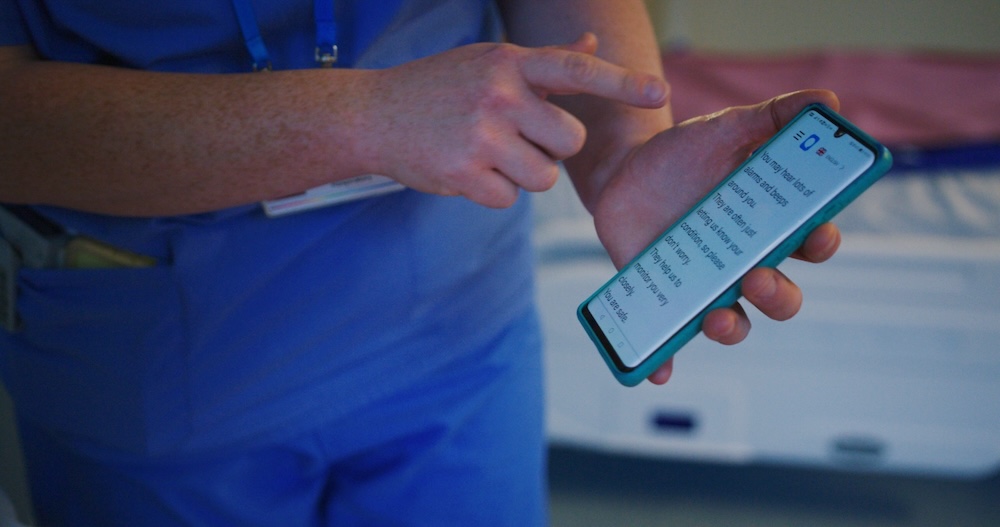
Doncaster and Bassetlaw Teaching Hospitals NHS Foundation Trust has launched a new 12 month pilot of CardMedic, a clinically validated app designed to transform communication with patients across any barrier – whether language, visual, hearing or cognitive impairment.
The initiative, funded by the Doncaster and Bassetlaw Teaching Hospitals Charity, aims to reduce health inequalities by ensuring all patients receive the same level of information and care, regardless of language, sensory or cognitive barriers.
The Trust began with a soft launch in October across four key areas before rolling out trust wide in December 2025.
Kirsty Clarke, Associate Chief Nurse at Doncaster and Bassetlaw Teaching Hospitals, said: “Every patient should get the same level of information, but we’ve identified a significant gap in accessibility for patients whose first language isn’t English.
“Too often, DBTH colleagues rely on gestures and mimes to communicate essential health information – from explaining why a urine sample is needed to taking blood pressure. This isn’t acceptable when it comes to patient safety and dignity.”
The CardMedic app will enable healthcare staff to have continuous, accurate conversations with patients throughout their care journey, without the need for interpreters to be present for every interaction, which sometimes isn’t possible.
The soft launch will focus on four key departments; emergency department at Doncaster, maternity services, fracture clinic and outpatient services.
These areas were selected to test the app across different patient pathways, from emergency situations requiring immediate communication to routine appointments where detailed information sharing is essential.
Jeanette Cliff-Taylor, Accreditation Lead Nurse, said: “There has been excellent engagement so far and colleagues working at the Trust can definitely see the benefits.
“We’ve already identified numerous scenarios where CardMedic will make an immediate difference – from eye clinics explaining vision tests to reception staff communicating with patients about appointments.”
Unlike informal translation methods such as Google Translate, CardMedic uses clinically validated scripts that have been professionally reviewed to ensure accuracy and appropriateness for healthcare settings.
Kirsty emphasised this crucial distinction: “The cards have been validated and reviewed.
“It’s information we know is accurate, giving credibility to patient conversations.
“Previously, staff have found workarounds, but from a quality perspective, when it is not possible for us to use an interpreter face to face, we needed a solution that provides the detailed information we would give to any English-speaking patient accessing our services.”
The app will support not only direct patient care but also communication with family members and carers who may require information in their preferred language, further reducing health inequalities across the patient experience.
Following the December trust-wide launch, the pilot will run for ten months with regular evaluation to measure impact on patient experience, staff confidence and care quality. The Trust plans to gather feedback throughout the pilot period and assess the difference it makes to patient treatment and care.
Tim Grimaldi, o-founder and Managing Director of CardMedic, said: “We’re delighted to be working with Doncaster and Bassetlaw Teaching Hospitals on this vital initiative.
“Communication is fundamental to safe, compassionate care, yet language barriers continue to create significant health inequalities across the NHS.
“CardMedic empowers healthcare professionals to have meaningful conversations with every patient, ensuring nobody is left behind simply because English isn’t their first language.
“This pilot demonstrates the Trust’s genuine commitment to equitable care and we’re excited to see the positive impact it will have on both patients and staff.”

 ‘First’ femtech app to protect user data from governments emerges from stealth