



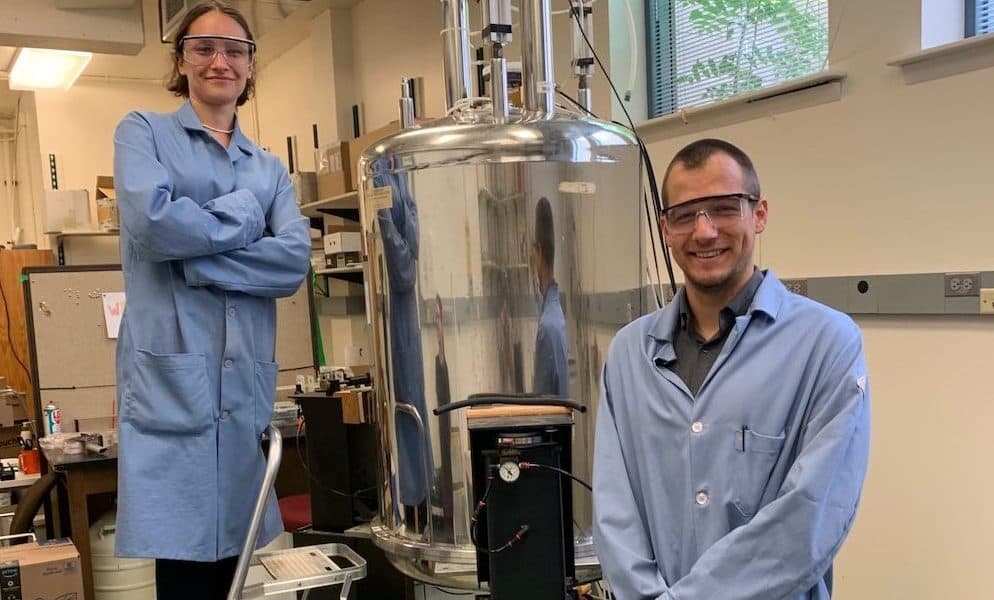
Researchers at Colorado State University have created a cobalt-based molecule to be a noninvasive chemical thermometer.
The breakthrough toward their goal of making new magnetic imaging probes with extreme temperature sensitivity was published in the Journal of the American Chemical Society.
“Not only does this work show promise in the medicinal field, but the basic steps and theory may lead to steps forward in the quantum computing realm.
“We may find even more applications as we continue our research,” said Department of Chemistry Assistant Professor Joseph Zadrozny.
MRI
The noninvasive, life-saving technique known as magnetic resonance imaging (MRI) works by aligning hydrogen atoms in a strong magnetic field and pulsing radiofrequency waves to convert the response of those atoms into an image.
The field of provenance for MRI, it could be argued, is chemistry – MRI works by exploiting the inherent magnetic properties of individual atoms.
What if, instead of just creating images, an MRI machine could extract detailed information about the chemistry of the body – say, the pH levels in the vicinity of a tumour, or the temperature anomalies that occur around an injury?
What if the physical principles of magnetic imaging could be applied to all sorts of chemical changes, down to the level of atoms and molecules, and could give us unparalleled new insights into human health and disease?
These ‘what if’ questions drive the work of Zadrozny and his team of students and researchers.
An inorganic chemist who toes the line between chemistry and quantum physics, Zadrozny has built a lab for the design of molecules that allow magnetic resonance imaging to do things that it currently cannot.
In doing so, the researchers are uncovering fundamental insights into how the magnetic properties of metal ion-containing molecules respond to their environments, whether that means extremely small shifts in temperature, pH or other metrics.
“We are living, breathing, talking chemical reactors,” Zadrozny said. “If you could image that chemistry, it would be really powerful.”
Like an electron
Zadrozny and his team’s paper describes a cobalt-based molecule they have engineered to be a noninvasive chemical thermometer.
They used their expertise in molecular design to make the cobalt complex’s nuclear spin – a workhorse, fundamental magnetic property – mimic the agile, but less stable sensitivity of an electron’s spin.
‘Spin’ is what gives subatomic particles their magnetism.
By making the cobalt nucleus essentially act like an electron, they have shown that this special cobalt complex could someday form the basis for a powerful molecular imaging probe that could read out extremely subtle temperature shifts inside the body.
The imagination could run wild for how this phenomenon could be used, a press release from the university said. Doctors could detect the minutest temperature shifts around a still-invisible tumour.
An in-office thermal ablation procedure could take on molecular-level precision, killing off diseased tissue while avoiding healthy tissue.
Creating a temperature-sensing probe with the cobalt material, which in a doctor’s office might someday be injected or ingested in order to communicate temperature signals from the body, would take advantage of the controllable magnetism of a nucleus.
It would also have the desirable property of information readout via radiofrequency waves, which are safe for the human or animal body.
Such a magnetic probe would also work at room temperature, the researchers envision.
Using the magnetic properties of spinning electrons – a popular area of study for physicists trying to make quantum computers – is less ideal for biomedical imaging.
One reason: exploiting the magnetism of electrons requires microwaves, which are dangerous for humans.
Nor would such electron-based probes work at room temperature – they would need to be much colder.
Experiments
To run their experiments, Zadrozny’s team led by postdoctoral researcher Ökten Üngör designed the cobalt molecule and tested its temperature sensitivity using a 500-megahertz nuclear magnetic resonance spectrometer located in the CSU Analytical Resources Core (ARC).
The ARC is a research-managed shared facility located in the chemistry building that allows researchers across campus to conduct research via cutting-edge analytical instrumentation.
“We showed, via nuclear magnetic resonance experiments, that the sensitivity outperformed comparable molecules by orders of magnitude,” Üngör said.
A wide array of applications could be in store for the researchers’ cobalt molecule.
“The chemistry around the cobalt atom is highly tunable, and we can control it to a high degree,” Üngör said.
“Not only does this work show promise in the medicinal field, but the basic steps and theory may lead to steps forward in the quantum computing realm.
“We may find even more applications as we continue our research.”
The team may next explore enhanced design of the cobalt-based imaging probe to make it more stable in aqueous solution.
For now, the temperature sensitivity of the material is astounding, but the molecule is not robust enough to survive in the body for a long time, which would be necessary in a medical application.