




Six care & housing providers have been awarded £440k to co-produce tech services with older residents.
Seniors at Bield Housing & Care, Haringey Council, Platform Housing Group, Pobl Group, Southend Care and Wiltshire Council will benefit from between £65k – £75k in funding – in order to “shape” new digital services that improve their health and independence.
The funding is part of the pioneering TAPPI project (Technology for our Ageing Population: Panel for Innovation) which aims to improve the way technology is used in housing and care for older people through ten practical principles.
Tech to improve lives of care & housing residents
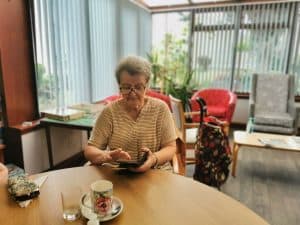
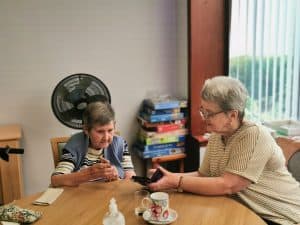
Various devices, apps and tech systems are to be tested on the older people in each care and housing organisation – all in varied housing settings. The idea is that residents will be given shared responsibility, alongside staff, to make decisions about which digital support services to develop.
It is hoped that this approach will help Bield Housing & Care, Haringey Council, Platform Housing Group, Pobl Group, Southend Care and Wiltshire Council to create digital services across England, Scotland and Wales that are determined by their residents, alongside the professionals and staff that support them.
Companies in the project
To facilitate this process, the TAPPI project has appointed Co-production Works, a specialist consultancy that supports organisations to work in co-production with people who use services. Co-production Works will train residents and staff and pay participants for their time.
The Cambridge Centre for Housing and Planning Research (CCHPR) – part of the University of Cambridge – has been appointed to evaluate the TAPPI project. Researchers will work with the six housing providers to quantify benefits from their work and share what they’ve learnt with the wider housing and care sector.
Cllr Jane Davies, cabinet member for adult social care, SEND, transition and inclusion at Wiltshire Council said: “It is important that older people who need support are given the opportunity to live their lives fully and independently.
“Harnessing the benefits of modern technology so they can enjoy this independence for longer is going to be a key part of all our plans for the future. Testing this new technology at one of our extra care homes is an exciting development which will help us understand more of how we can use technology enabled care to help people for the future.”
Dr Lynne Douglas, CEO, Bield Housing & Care, added: “We are very excited to be the Scottish testbed for TAPPI2. This has huge potential to shift thinking on how housing can be integral to new models of delivery in the integration agenda. Most importantly, it will be delivered together with older people to improve the outcomes that matter to them.”
Tech can “play a key role” in senior happiness
Caroline Humphrey, transformation project lead, London Borough of Haringey said: “Our homes should be places where we feel happy and safe, but as our needs change they need to adapt with us – and that can be hard.
“We believe that technology can play a key role in supporting people in living their best lives independently at home and we are excited to be part of the TAPPI2 Project.”
A golden opportunity
Stephen Unsworth, director of operations at Southend Care said: “This is a golden opportunity to collaborate with our technology partner Amba, Southend City Council and tenants to test the impact of deploying technology augmented care in people’s homes.
“This important work will determine how people’s independence can be maintained or enhanced and, in turn, support Southend Care’s progress in becoming a technology-enabled company.”
Professor Roy Sandbach OBE, TAPPI Chair and former Director of the National Innovation Centre for Ageing at Newcastle University said: “The TAPPI principles will only be of value if they are applied in practice, and I’m thrilled that many housing and care organisations applied to become TAPPI testbeds.
“Those chosen will provide insights from a range of settings and, most importantly, will put users at the heart of this work. We’ll use the TAPPI principles and a co-production approach to develop digital services that address real-life problems of older people. I’m very excited to work with our six new testbed sites.’
Led by the Housing Learning and Improvement Network (Housing LIN), the TEC Services Association (TSA) and funded by the Dunhill Medical Trust, the TAPPI project will co-produce new tech tools with people who have lived experience over a 12 – 15-month period.
Don’t miss…
“VR makes me smile again” – emotional, virtual “field trips” for hospice patients