


Cilia are microscopic hairs which move fluid by rhythmic beating. They are responsible for pushing cerebrospinal fluid in the brain, clearing phlegm and dirt from lungs, and keeping other organs and tissues clean.
A technical marvel, cilia have proved difficult to reproduce in engineering applications, especially at the microscale.
Cornell University researchers have now designed a micro-sized artificial cilial system using platinum-based components that can control the movement of fluids at such a scale.
The technology could someday enable low-cost, portable diagnostic devices for testing blood samples, manipulating cells or assisting in microfabrication processes.
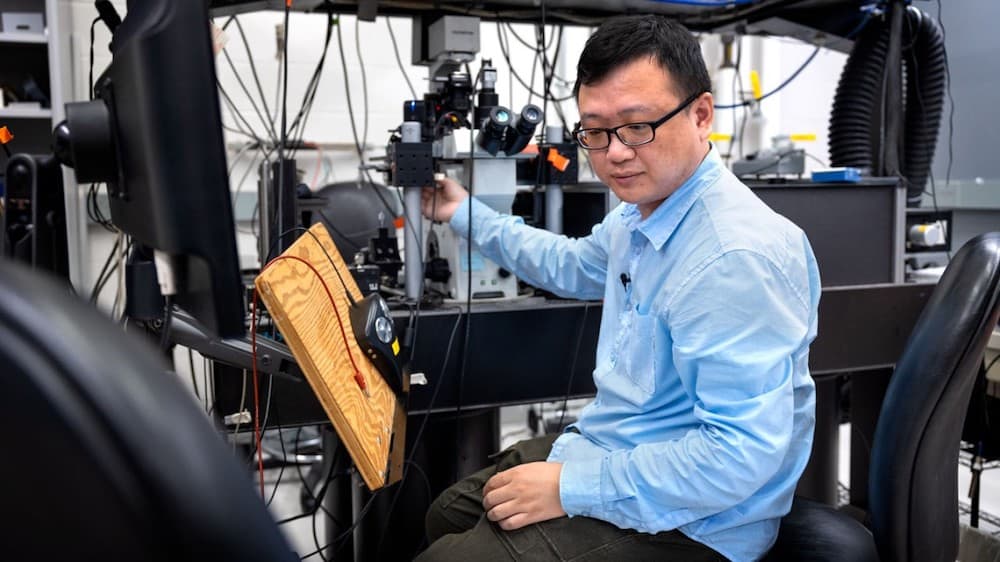
The US group’s paper, ‘Cilia Metasurfaces for Electronically Programmable Microfluidic Manipulation’, was published on May 25 in Nature. The lead author is doctoral student Wei Wang.
“There are lots of ways to make artificial cilia that respond to light, magnetic or electrostatic forces,” Wang said.
“But we are the first to use our new nano actuator to demonstrate artificial cilia that are individually controlled.”
The mechanics
The project is led by the paper’s senior author, Itai Cohen, professor of physics in the College of Arts and Sciences.
It builds off a platinum-based, electrically-powered actuator – the part of the device that moves – that his group previously created to enable microscopic robots to walk.
The mechanics of those bending bot legs is similar, but the cilia system’s function and applications are different, and quite flexible.
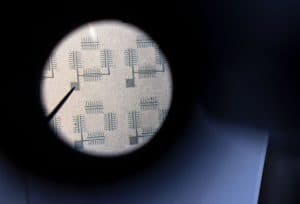
A typical device contains a ‘carpet’ of about a thousand artificial cilia (Image: Noël Heaney/Cornell University)
“What we’re showing here,” Cohen said, “is that once you can individually address these cilia, you can manipulate the flows in any way you want.
“You can create multiple separate trajectories, you can create circular flow, you can create transport, or flows that split up into two paths and then recombine. You can get flow lines in three dimensions. Anything is possible.”
“It’s been very hard to use existing platforms to create cilia that are small, work in water, are electrically addressable and can be integrated with interesting electronics,” Cohen said.
“This system solves these problems. And with this kind of platform, we’re hoping to develop the next wave of microfluid manipulation devices.”
A carpet
A typical device consists of a chip that contains 16 square units with eight cilia arrays per unit, and eight cilia per array, with each cilium about 50 micrometers long, resulting in a “carpet” of about a thousand artificial cilia.
As the voltage on each cilium oscillates, its surface oxidises and reduces periodically, which makes the cilium bend back and forth, allowing it to pump fluid at tens of microns per second.
The scientists can independently activate different arrays, therefore creating an endless combination of flow patterns mimicking the flexibility observed in their biological counterparts.
As a bonus, the team created a cilia device that is equipped with a complementary metal-oxide-semiconductor (CMOS) clock circuit – essentially an electronic ‘brain’ that allows the cilia to operate without being tethered to a conventional computer system.
That opens the door to the development of a host of low-cost diagnostic tests.
“You can imagine in the future, people taking this tiny centimetre-by-centimetre device, putting a drop of blood on it and conducting all the assays,” Cohen said.
“You wouldn’t have to have a fancy pump, you wouldn’t have to have any equipment, you would just literally put it under sunlight and it would work. It could cost on the order of $1 to $10.”
Co-authors include postdoctoral researchers Qingkun Liu and Michael Reynolds; former postdoctoral researchers Alejandro Cortese, Ph.D. ‘19 and Marc Miskin; Michael Cao ’14 , Ph.D. ‘20; David Muller, the Samuel B. Eckert Professor of Engineering; Alyosha Molnar, associate professor of electrical and computer engineering; Paul McEuen, the John A. Newman Professor of Physical Science; and Ivan Tanasijevic and Eric Lauga of the University of Cambridge.
The Army Research Office, the National Science Foundation, the Cornell Center for Materials Research, which is supported by the NSF’s MRSEC programme, the Air Force Office of Scientific Research and the Kavli Institute at Cornell for Nanoscale Science primarily supported the research.
The work was performed in part at the Cornell NanoScale Science and Technology Facility.