




Around one in seven couples have trouble conceiving, yet many struggle to access fertility treatment on the NHS. Alongside strict criteria dictating who can access treatment, candidates face a postcode lottery, with many forced to go private at a cost of £5,000 or more for a single round.
UK-based Béa Fertility is working to democratise fertility treatment with its at-home subscription service. The company is aiming for a UK market launch of early-to-mid 2023.
Health Tech World called up co-founder Tess Cosad to find out more.
Who are Béa Fertility and how does your at-home fertility treatment work?
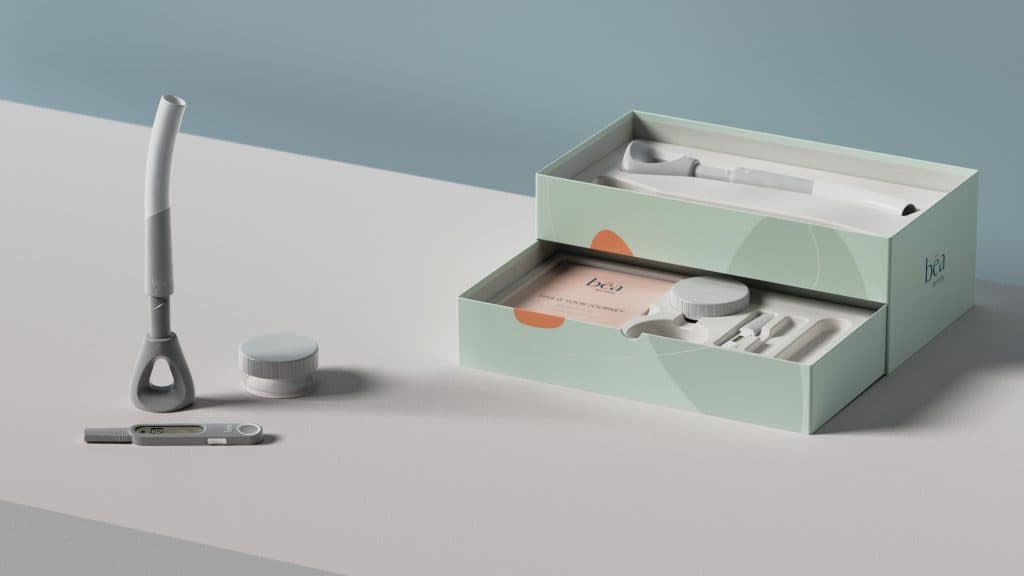
Béa is a home fertility care company. We are working to bring back a clinical treatment called intracervical insemination or ICI in a way that allows people perform the treatment at home.
ICI used to be widely available in the clinical environment in the ‘70s and ‘80s. But when IVF and IUI came along, ICI kind of fell out of favour.
It works by placing a silicone cap containing seamen at the cervix for four to six hours. It’s a really simple treatment.
The treatment kit also include hormone tests, semen collection containers – basically everything you need to carry through a single cycle of treatment. There is also a digital support companion to go alongside it.
We wanted to create something what was a tenth of the cost of the closest available clinical treatment; a product that people can use at home that has inclusion built into its core.
What makes your product inclusive?
Our product doesn’t require heterosexual intercourse. With this, LGBTQ families, single women and same sex female couples can start their families at home the way many of them want to.
From an access perspective, we’re looking at pricing this so that you can get five to six cycles for what you would pay for one cycle of clinical treatment.
The efficacy data for ICI is actually pretty strong. And there’s a lot of evidence to suggest that it compares over multiple cycles to the efficacy that we see with intrauterine insemination or IUI.
Why isn’t ICI commonly used anymore?
It’s not a very profitable treatment to offer if you’re a fertility clinic. Clinics are inhibited by only one thing, really – their physical footprint.
Some of the largest clinics in London can only do up to 2,000 cycles a year. So a clinic that only perform up to 2,000 treatment cycles a year is going to opt for IVF at £5,000 pounds a round as opposed to ICI at £200 pounds a round.
Are there any other ICI products on the market?
At the moment, no.
There are a couple of companies that are doing things that help hold semen in the vaginal canal. But I can’t say that they are truly ICI in the way that what we’re working on.
It’s really difficult to develop regulated medical hardware. It’s expensive, it’s a bit of a labour of love to get it to market. Accessing the capital to be able to build D2C medical devices is actually quite a nascent category.
We’re seeing a lot of D2C software in the medical world coming out, but we’re not seeing a lot of D2C hardware and treatment experiences.
It’s a little bit new for investors. Access to capital is certainly something that we struggled with a little bit to begin with.
Could you tell us more about the app?
Principally, it exists to support your treatment experience. It also exists to provide the connection to expert support that you would get in the clinical environment.
So as well as being led through your treatment at home, our app will enable you to direct message a physician, a gynaecologist, midwife, fertility expert or embryologist and receive the clinical and physician support that people should have as they’re starting their families.
Eventually, we’re looking at creating communities in the way that NCT exists for people who are pregnant.
I believe that we need to start talking about infertility and bringing people together on the journey so they can lean on each other. We would very much like to sit at the centre of facilitating and supporting that.