



Kidney stones are quite common, with up to 28 million individuals affected in Europe (1), and incidence peaking between the ages of 40 and 50.
The trend is on the rise due to among others, processed diets, climate change, sedentary lifestyles and increased medication use (2).
Kidney stones are clusters of crystals that form from minerals and other waste substances in the urinary tract.
While most stones are expelled through urination, larger stones may need to be broken up or removed with surgery.
Depending on stone size, location and symptoms, kidney stones may be treated with shock wave lithotripsy, percutaneous nephrolithotomy or ureteroscopy (3).
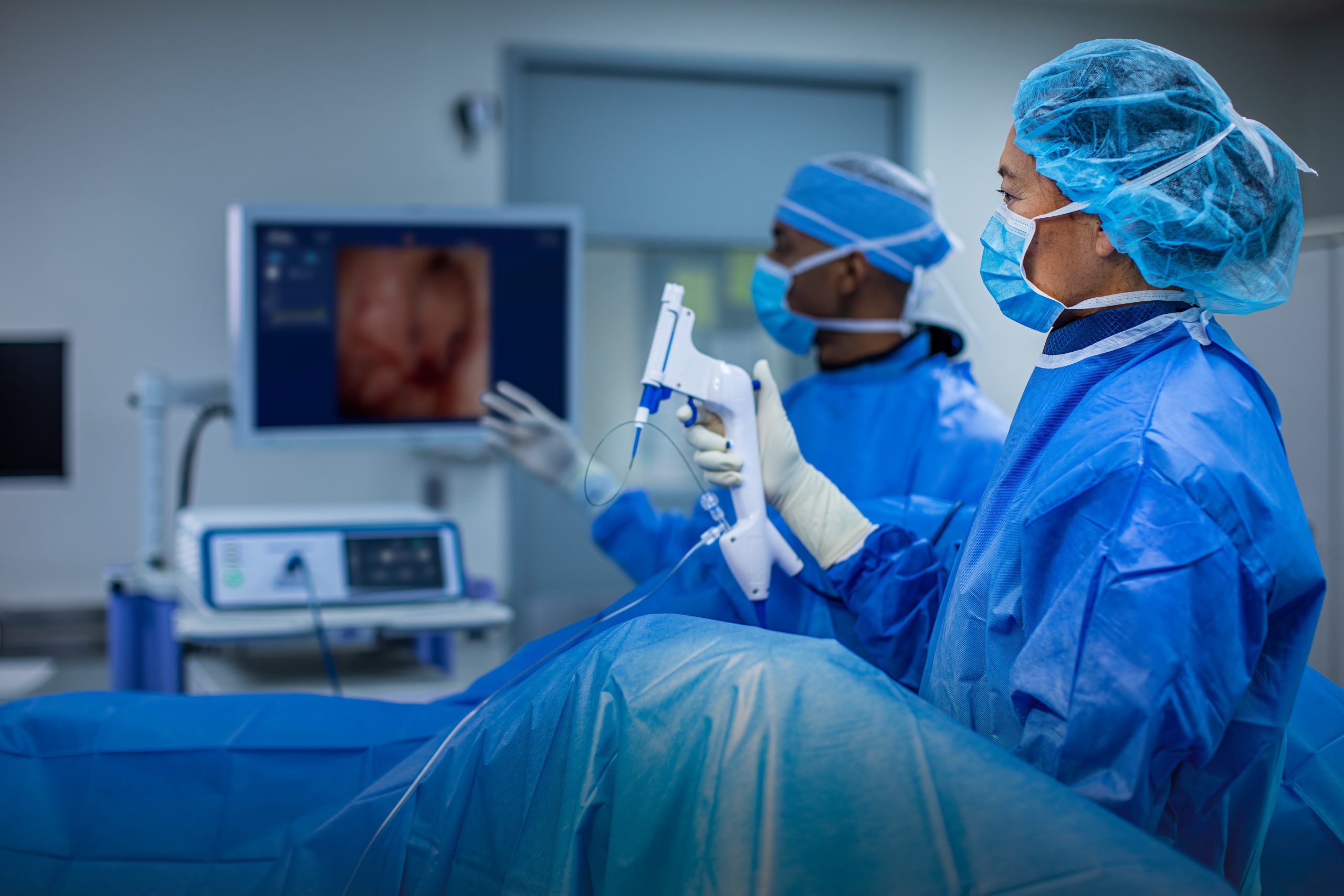
The latest innovations in kidney stone treatment took centre stage at this year’s European Association of Urology (EAU) Congress held in Madrid, among which were the first live procedures from Prof. Skolarikos from Sismanoglio General Hospital of Athens, Greece, using LithoVue Elite Single-Use Digital Flexible Ureteroscope System.
This next-generation device manufactured by Boston Scientific is the first ureteroscope with intrarenal pressure (IRP) monitoring, empowering urologists to make informed, real-time clinical decisions during flexible ureteroscopy.
New possibilities in ureteroscopy: monitoring intrarenal pressure in real-time
Ureteroscopy is a widely used, minimally invasive procedure for treating small- to medium-sized kidney stones (4).
The technique involves inserting a flexible ureteroscope through the urinary tract to locate and remove kidney stones.
It requires fluid irrigation for visibility, which increases pressure in the kidneys (5).
Recent evidence published in the Journal of the European Association of Urology highlighted that elevated intrarenal pressure during flexible ureteroscopy may be linked to higher risk of post operative complications, especially in high-risk patients (6).
Beyond the consensus achieved by the urologist community on the importance of measuring IRP, a survey from the Journal of Endourology revealed widespread concern about elevated intrarenal pressure, with 96 per cent of respondents indicating that they actively aim to reduce it during ureteroscopy (7).
Among the potential complications linked to high IRP, the most frequently cited were urosepsis (96.2 per cent), collecting system rupture (80.8 per cent), postoperative pain (67 per cent), bleeding (63.7 per cent), and long-term kidney damage (26.1 per cent).
By providing real-time IRP data, the LithoVue Elite System offers clinicians an opportunity to better understand and manage those potential risks during ureteroscopy.
“Measuring intrarenal pressure during flexible ureteroscopy allows the surgeon to better control the entire procedure,” said Prof. Skolarikos, reflecting on the procedure showcased at EAU 2025.
“It enables clinicians to actively change the surgical approach in real time, opening up possibilities to adjust the clinical practice.”
Innovations enhancing surgical precision
The innovations introduced with the LithoVue Elite System aim at supporting surgical precision: the enhanced imaging may drive more efficient procedures (8), and the built-in intrarenal pressure sensor enables continuous monitoring of pressure levels throughout the procedure.
Unlike traditional reusable ureteroscopes, the LithoVue Elite digital flexible ureteroscope is designed for single use, eliminating the risk of cross-contamination and reducing infection rates.
This disposable model also removes the costs and logistical challenges associated with maintenance and repairs (12).
Boston Scientific’s commitment to address unmet needs
Until now, urologists lacked a method to measure intrarenal pressure during ureteroscopy.
“This next-generation ureteroscope was developed in response to feedback from urologists on the importance of maintaining low intrarenal pressure for patient safety,” explains Miguel Aragon, vice president of Urology in Europe, Middle East and Africa at Boston Scientific.
“It exemplifies Boston Scientific’s commitment to developing innovative solutions that enhance patient care while improving surgical decision making.”
The LithoVue Elite System received CE mark approval in December 2024, and will be more widely available across European health care institutions in 2025.
CAUTION: The law restricts these devices to sale by or on the order of a physician. Indications, contraindications, warnings, and instructions for use can be found in www.IFU-BSCI.com. Products shown for INFORMATION purposes only and may not be approved or for sale in certain countries. This material not intended for use in France. 2024 Copyright © Boston Scientific Corporation or its affiliates. All rights reserved. Uro – 2153408 – AA
1. Data based on prevalence in absolute term in the following countries: Italy (Prezioso D, Illiano E, Piccinocchi G, Cricelli C, Piccinocchi R, Saita A, et al. Urolithiasis in Italy: An epidemiological study. Arch Ital di Urol e Androl. 2014;86: 99–102.doi:10.4081/aiua.2014.2.99); Spain (Morales-Martínez A, Melgarejo-Segura MT, Arrabal-Polo MA. Urinary stone epidemiology in Spain and worldwide. Arch Esp Urol. 2021;74: 1–3); France (Daudon M. Epidemiology of nephrolithiasis in France. Ann Urol (Paris). 2005;39: 209–231. doi:10.1016/j.anuro.2005.09.007); UK (Heers H, Turney BW. Trends in urological stone disease: a 5-year update of hospital episode statistics. BJU Int. 2016;118: 785–789. doi:10.1111/bju.13520); Germany (2. Fisang C, Anding R, Müller SC, Latz S, Laube N. Urolithiasis – An interdisciplinary diagnostic, therapeutic and secondary preventive challenge. Dtsch Arztebl Int. 2015;112: 83–91. doi:10.3238/arztebl.2015.0083)
2. https://my.clevelandclinic.org/health/diseases/15604-kidney-stones last accessed March 2025
3. EAU Patient information. Ureteroscopy (fURS).https://patients.uroweb.org/condition/kidney-and-ureteral-stones/treatment-of-kidney-stones Last accessed March 2025
4. See ref. 3
5. Tokas T, Herrmann TRW, Skolarikos A, et al. Pressure matters: intrarenal pressures during normal and pathological conditions, and impact of increased values to renal physiology. World J Urol. 2019 Jan;37(1):125-31.</p.
6. Somani, B., N. Davis, E. Emiliani, M. I. Gökce, H. U. Jung, E. X. Keller, A. Miernik et al. Expert consensus on high intra-renal pressure during ureteroscopy: A pan-European delphi panel. https://doi.org/10.1016/j.euros.2025.01.005</p.
7. Croghan SM, Somani BK, Considine SW, et al. Perceptions and practice patterns of urologists relating to intrarenal pressure during ureteroscopy: findings from a global cross-sectional analysis. J Endourol 2023;37:1191–9. https://doi.org/10.1089/end.2023.0346.