
From saving surgeons’ precious time, to reducing surprises and clinical risks in theatre, cutting MDT time in half, and informing decisions before procedures, surgical teams in the SWASH+ consortium of NHS trusts are embracing a ’game changer’ in orthopaedic planning technology with Sectra.
David Howard, orthopaedic surgical practitioner at Hampshire Hospitals NHS Foundation Trust, gives the detail.
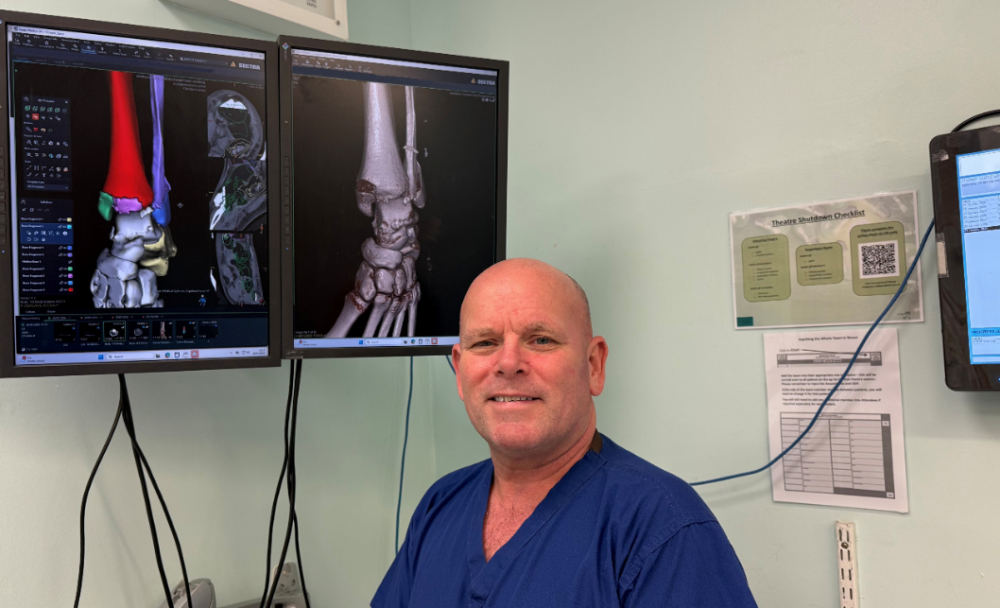
When David Howard was planning for a complex trauma operation, he impressed surgeons. A newly implemented pre-operative 3D planning tool allowed the orthopaedic surgical practitioner to virtually reconstruct the patient’s fracture, and present it to the registrar and consultant at a trauma meeting before going into theatre.
“I showed them the 3D reconstructed fracture,” he says. “With a click, we then reset the fragments to show the original trauma, and were able to remove larger fragments on screen, revealing where the smaller ones needed to go. Well ahead of the first incision, this let us prioritise fragments, correct angulation, and restore anatomy, removing surprises in theatre.”
The surgeons’ response to what Mr Howard describes as “significant step forward in orthopaedic planning technology” was simple: “Wow, why have we not had this before?”
“This is a game changer,” he says. “To be able to rehearse, see where fragments lie, and the direction and rotation needed to reassemble the fracture.”
His account describes one of many benefits being realised by surgical teams in the SWASH+ consortium after deploying a surgical planning solution from Sectra, the consortium’s medical imaging IT provider.
The SWASH+ consortium includes University Hospital Southampton NHS Foundation Trust, Portsmouth Hospitals University NHS Trust, Hampshire Hospitals NHS Foundation Trust, Hampshire and Isle of Wight Healthcare NHS Foundation Trust and Salisbury NHS Foundation Trust.
Mr Howard has led on implementing and refining the software from Hampshire Hospitals NHS Foundation Trust.
A ‘phenomenal’ MDT workflow: Saving time, enhancing safety
Mr Howard, who has worked closely with Sectra as part of this deployment, has spent 23 years in the orthopaedic department at Basingstoke and North Hampshire Hospital. He describes a “very heavy load in pre-operative planning and templating” in his role today, and stresses significant efficiencies that the new technology now enables.
Preparation for an osteotomy, for example, would have taken a minimum of 10 minutes using previous third-party systems. “I can now do multiple plans in the same time using Sectra with the same precision,” he says. “We never rush plans, but we have confidence in the system. The workflow is amazing, there’s a massive time and efficiency saving.”
Time savings for multi-disciplinary team meetings has been “phenomenal,” he adds. “Every single time, for every single case, people within the MDT are saving up to 50% of their time compared to not having this system.”
“It is incredible how quickly we can now get through an MDT workflow,” he says. “Once images are templated, in a single click all the imaging you need is displayed. We can run through two weeks of pre- and post-operative cases in 30 minutes comfortably.
‘Everyone knows what they are doing two weeks in advance’
Efficient preparation at MDT is helping to reduce risk of error, says Mr Howard, with images organised to a demonstration folder beforehand.
“They have all been assessed and validated before the MDT,” he says. “Preparation is done in a colder, more controlled area.
“We have a workflow that gives us a more relaxed approach to time-pressured MDTs.”
“This means better decisions for patient care,” he says. “We have a high standard of pre-op planning – with fellows and registrars. All come together in one meeting where we now have realised the benefits of this software.”
A reduction in stress is the consequence, and surgical teams are better prepared.
“Everyone knows what they are doing weeks in advance,” says Mr Howard.
“Surgeons have a better patient history, and a better understanding of what they will encounter. That means they can become more engaged with the patient, speak to them and tell them what they are planning when operating.”
Changing surgical approaches, improving safety
Having better information has led to changes in surgical approaches.
“On a recent elbow case, surgeons were able to make a single incision, rather than two incisions, on the understanding that if you find the primary fragment, everything else falls into place,” he explains.
Distal femoral replacement procedures are also now more efficient and safer, says Mr Howard.
“Because we can rehearse and reconstruct to a millimetre, surgeons in theatre were able to do a single cut and re-built the femur in minutes.”
“Before we started the operation, the segment and the final part of the construct was built. As soon as we had done our resection, we put our prosthesis in, put the leg out into full extension, and everything worked.
“If you don’t have this information, you have to use clamps and clips, and rebuild the fracture on the patient, or estimate a cut and start building an implant up, which can take 30 to 40 mins.”
Action taken means less risk and reduction of blood loss: “Now fragments can be removed with fewer surprises. We can get a clean cut and remove the risk of vascular damage.”
More information for the whole surgical team also means enhanced focus during procedures.
“We told the theatre staff exactly what to put together before the patient was in the anaesthetic room,” says Mr Howard.
“By the time they came into theatre, all the implants had been built, freeing up the scrub nurse to do their job to assist the surgeon, not to have their back to them working on some other scenario on the set.”
Outstanding collaboration, empowered, and future ready
Mr Howard praises a collaborative approach, and “outstanding support and engagement” from Sectra in maximising impact on clinical practice.
That value is already being realised in cost-efficiencies.
In addition to making more use of time in theatre, MDTs, and during planning, he says that tools have “empowered us to confidently carry out complex cases without relying on expensive third-party orthopaedic solutions.”
“Sectra has given us the confidence and capability to bring high-level planning in-house, delivering both clinical and cost-effective benefits,” he says.
“Overall, the new package is a comprehensive, future-ready solution that finally delivers the innovation and functionality the orthopaedic department here in the SWASH+ consortium has long needed.”