



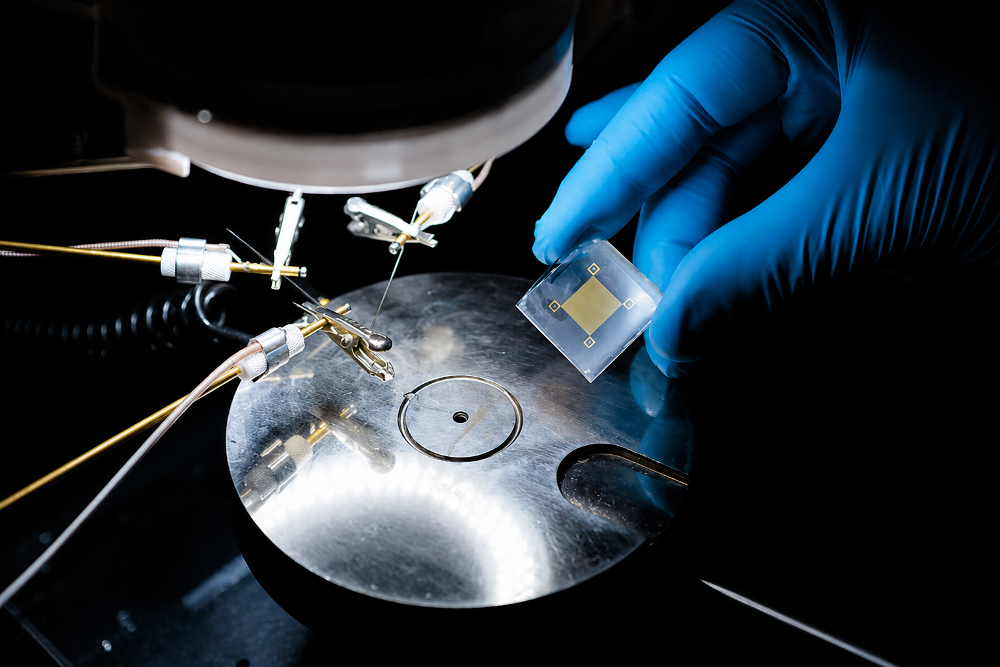
A skin-like AI patch can analyse health data on the body in milliseconds without sending information to an external computer.
Unlike current wearables that track signals such as heart rate or movement, the device carries out AI calculations directly on the body.
Researchers said that could matter in cases such as ventricular fibrillation, where even a delay of a few seconds in sending data to a remote server may be too long.

The patch was developed at the University of Chicago Pritzker School of Molecular Engineering in collaboration with researchers at Argonne National Laboratory.
The device was made possible by manufacturing processes that allow organic electrochemical transistors to be printed onto flexible surfaces.
Sihong Wang, associate professor of molecular engineering at UChicago PME and co-senior author of the study, said: “The future that we’re trying to realise is to make wearable and implantable devices smarter.
“It’s helping people have a personal, instantaneous doctor integrated into their devices.”
For years, Wang’s lab has been working to create electronic components that can stretch and bend like human skin, with the aim of producing smart devices that can adhere to human tissue.
The group had previously developed methods for fabricating stretchable transistor arrays and a stretchable OLED display.
In the new work, the team built a stretchable neuromorphic computing circuit, a system designed to process information in a way inspired by the brain.
Earlier research had shown the concept was possible with a small number of transistors, but had not scaled it to a practical size.
The transistors used in the device, known as organic electrochemical transistors, process information using electrical current and the movement of ions, which are charged particles, through a gel-like electrolyte layer.
That electrolyte layer gives each transistor a form of built-in memory, allowing it to store numerical values in a way researchers compare with how brain connections can strengthen or weaken.
A major challenge was manufacturing the flexible devices, as the surface layer is sensitive to heat and solvents, while the gel electrolyte layer can move and merge with neighbouring devices, causing short circuits.
Wang said: “What we had to ask was whether we could use or change the properties of these polymers to make them compatible with photolithography, the main patterning method used in the microelectronics industry.”
The researchers engineered a polymer gel that can be hardened into precise patterns using ultraviolet light.
The method can produce 10,000 organic electrochemical transistors per square centimetre.
Zixuan Zhao, graduate student at UChicago CS and co-first author of the study, said: “As computer scientists, we’re used to thinking of a neural network weight as just a number.
“In hardware, it’s a material, with variability, history, and physical limits. The challenge was to hold those constraints in mind and still compute with enough precision to matter.”
To test the device, the team used a stretchable array to run a pre-trained algorithm designed to help treat ventricular fibrillation.
Ventricular fibrillation is a dangerous electrical storm in the heart in which the lower chambers quiver instead of pumping blood properly. It can be fatal without rapid treatment.
The condition is most often treated with a defibrillator shock, but researchers have proposed a more precise approach that maps abnormal waves of electricity through the heart and delivers small pulses just ahead of them.
The obstacle has been time, because those electrical wavefronts move through the heart in milliseconds.
Wang said: “This is a situation where it’s not feasible to have remote computing. It just takes too long.
“But if you have a computing device that can do the analysis within the body, it could be possible.”
Using real cardiac mapping data from a donor human heart, the team showed that the stretchable array could locate wavefront positions with 99.6 per cent accuracy, even when stretched to more than one and a half times its normal length.
In a separate demonstration, a neural network encoded in the array analysed a combination of vital signs and personal health data, including cholesterol levels, blood sugar, maximum heart rate and ECG readings.
An ECG, or electrocardiogram, records the electrical activity of the heart.
The system assessed a patient’s risk of heart attack with 83.5 per cent accuracy.
Wang said the computing array could form one part of a fully integrated, body-compatible health platform.
His lab is now working to pair the computing array with stretchable wireless communication components and improved sensors, moving towards a system that can sense, analyse and respond to health data as an integrated whole.
Fangfang Xia, computer scientist at Argonne National Laboratory and co-senior author of the study, said: “Instead of sending data away to a remote server, we can begin making sense of it right where life is happening.”
 When sound drives wellness: Music's expanding role in health platforms