



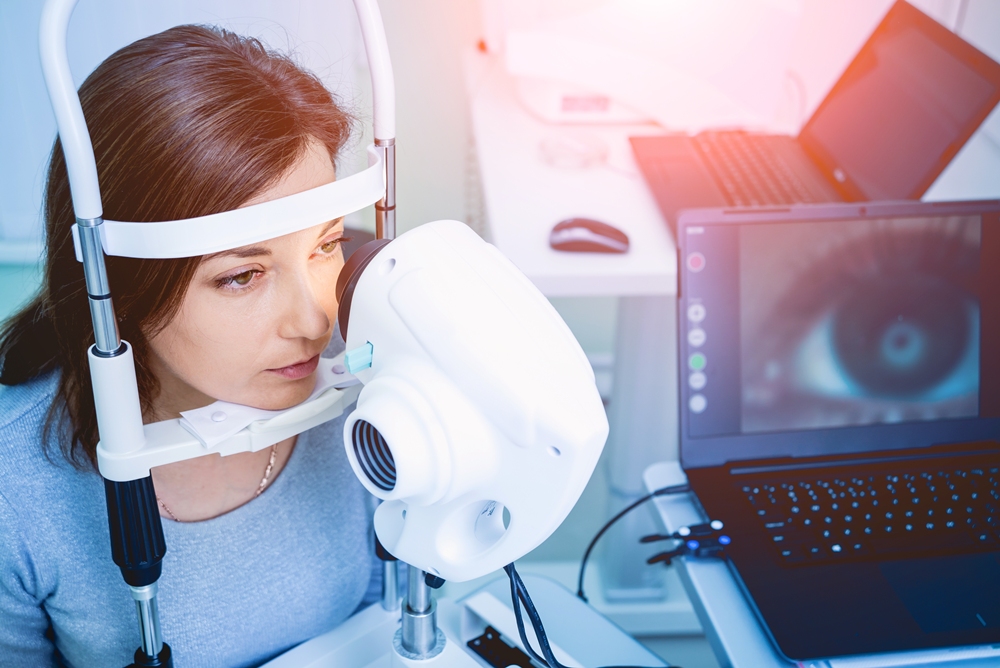
A partially sighted woman has regained vision after doctors tried a new eye injection using a low-cost, transparent gel.
Nicki can now see and read most lines of letters on an eye test chart, after previously relying on a magnifying glass for close-up tasks and navigating largely by memory.
She is one line away from what is legally required for driving.

The treatment was developed by specialists at Moorfields Eye Hospital for patients with hypotony, a condition where pressure inside the eyeball drops dangerously low and the eye can cave in on itself.
It can happen if the eye produces too little of its natural jelly-like fluid, for example after trauma or inflammation, and can also be a side effect of eye surgery or certain medications.
Without treatment, people can go blind.
Doctors have previously tried steroids and silicone oil to plump up the eye, but this can be toxic over long periods and does not restore much vision.
Even when the cells at the back of the eye used for sight are still working, silicone oil is difficult to see through, causing blurry vision.
The Moorfields team decided to try a different approach using hydroxypropyl methylcellulose (HPCM), a low-cost, transparent, water-based gel already used in some types of eye surgery.
Rather than using it as a one-off, they injected it into the main part of the eye as a new type of therapy.
When Nicki first had eyesight problems in 2017, just after her son was born, she was given lots of silicone oil in her right eye, which was failing.
She said it had lost its normal shape and had “sort of collapsed” or “crumpled like a paper bag” due to hypotony.
The treatment did little to help, and a few years later her left eye started to fail in the same way.
“After I lost vision in my left eye, I thought, ‘there has to be something else we can try’,” she said.
“Sheer determination. I was just like ‘I’m not giving up'”.
Her ophthalmic surgeon Mr Harry Petrushkin said they decided to do something new: fill the eye with something you can see through.
“The idea that we might be causing harm to somebody who has only really one eye with a treatment that may or may not work was nerve-wracking,” he said.
“We came up with this as a solution and amazingly it worked.
“Really, we could not have dreamt of her having the outcome that she has had.
“Somebody, who by all rights should have lost her vision in both eyes… is now living normally. That’s completely remarkable. We couldn’t have hoped for better.”
He said the same treatment could potentially help hundreds or even thousands of people each year in the UK, depending on whether patients still have viable cells at the back of the eye that allow vision.
The team has treated 35 patients so far, thanks to funding from the Moorfields Eye Charity, and has published outcomes from the first eight patients.
The treatment is given once every three to four weeks for around 10 months in total.
“It’s been a fantastic story. The results are really promising but it’s early days,” said Petrushkin.
Nicki said: “If my vision stays like this for the rest of my life it would be absolutely brilliant.
“I may not ever be able to drive again but I’ll take that!”