


Researchers in the US are one step closer to creating a technology that recreates tactile feedback, giving nuanced “feeling” to prosthetic hands.
The technology would allow people with spinal cord injuries not only to control a bionic arm with their brain, but also feel tactile edges, shapes, curvatures and movements, that until now have not been possible.
Charles Greenspon, PhD is a neuroscientist at the University of Chicago.
He said: “Most people don’t realise how often they rely on touch instead of vision — typing, walking, picking up a flimsy cup of water.
“If you can’t feel, you have to constantly watch your hand while doing anything, and you still risk spilling, crushing or dropping objects.”
The new studies build on years of collaboration among scientists and engineers at a number of US universities.
Together they are designing, building, implementing and refining brain-computer interfaces (BCIs) and robotic prosthetic arms aimed at restoring both motor control and sensation in people who have lost significant limb function.
The researchers’ approach to prosthetic sensation involves placing tiny electrode arrays in the parts of the brain responsible for moving and feeling the hand.
On one side, a participant can move a robotic arm by simply thinking about movement, and on the other side, sensors on that robotic limb can trigger pulses of electrical activity called intracortical microstimulation (ICMS) in the part of the brain dedicated to touch.
For about a decade, Greenspon explained, this stimulation of the touch centre could only provide a simple sense of contact in different places on the hand.
He said: “We could evoke the feeling that you were touching something, but it was mostly just an on/off signal, and often it was pretty weak and difficult to tell where on the hand contact occurred.”
The newly published results mark important milestones in moving past these limitations.
In the first study Greenspon and his colleagues focused on ensuring that electrically evoked touch sensations are stable, accurately localised and strong enough to be useful for everyday tasks.
By delivering short pulses to individual electrodes in participants’ touch centres and having them report where and how strongly they felt each sensation, the researchers created detailed “maps” of brain areas that corresponded to specific parts of the hand.
The testing revealed that when two closely spaced electrodes are stimulated together, participants feel a stronger, clearer touch, which can improve their ability to locate and gauge pressure on the correct part of the hand.
The researchers also conducted exhaustive tests to confirm that the same electrode consistently creates a sensation corresponding to a specific location.
The complementary paper went a step further to make artificial touch even more immersive and intuitive.
Greenspon said: “Two electrodes next to each other in the brain don’t create sensations that ‘tile’ the hand in neat little patches with one-to-one correspondence; instead, the sensory locations overlap.”
The researchers decided to test whether they could use this overlapping nature to create sensations that could let users feel the boundaries of an object or the motion of something sliding along their skin.
After identifying pairs or clusters of electrodes whose “touch zones” overlapped, the scientists activated them in carefully orchestrated patterns to generate sensations that progressed across the sensory map.
Participants described feeling a gentle gliding touch passing smoothly over their fingers, despite the stimulus being delivered in small, discrete steps.
The scientists attribute this result to the brain’s remarkable ability to stitch together sensory inputs and interpret them as coherent, moving experiences by “filling in” gaps in perception.
The approach of sequentially activating electrodes also significantly improved participants’ ability to distinguish complex tactile shapes and respond to changes in the objects they touched.
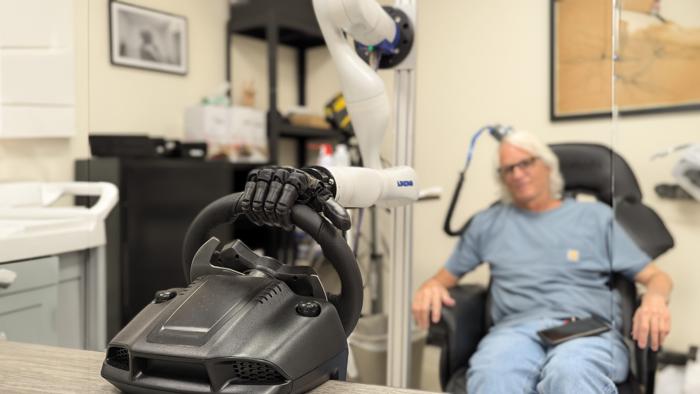
They could sometimes identify letters of the alphabet electrically “traced” on their fingertips, and they could use a bionic arm to steady a steering wheel when it began to slip through the hand.
These advancements help move bionic feedback closer to the precise, complex, adaptive abilities of natural touch, paving the way for prosthetics that enable confident handling of everyday objects and responses to shifting stimuli.
The researchers hope that as electrode designs and surgical methods continue to improve, the coverage across the hand will become even finer, enabling more lifelike feedback.
Co-author Robert Gaunt, PhD is associate professor of physical medicine and rehabilitation and lead of the stimulation work at the University of Pittsburgh.
He said: “We hope to integrate the results of these two studies into our robotics systems, where we have already shown that even simple stimulation strategies can improve people’s abilities to control robotic arms with their brains.
Image: Charles Greenspon, University of Chicago